
In those blessed times when the kingdom of Yundexburg began to grow apace, the sovereign's counsellors came to the conclusion that the old roads were no longer sufficient for further prosperity. The merchants complained of slow delivery of goods, the messengers of having to ride round half the continent for the sake of a single letter, and the treasury maintained that without an expansion of foreign trade the further growth of the economy would be in jeopardy.
This last argument made the greatest impression on the sovereign, for the treasury could have justified economic growth even if every road in the kingdom led in one direction only, preferably towards the treasury. To further prosperity on the western edge of the realm, in the Margraviate of Mamsterdam, a new castle was built, which was to connect Yundexburg with the outside world.
At the grand opening the head of the project reported to the sovereign that the plan had been fulfilled one hundred per cent and showed a handsome chart of growing throughput, receiving a bonus for the early launch. Nobody, as usual, had properly inspected the gates, and by tradition only carts of a certain width could pass through them, but this was inessential, and the trials were postponed to the next financial quarter, since in the current quarter all resources had been directed towards the achievement of strategic goals and the payment of bonuses.
But in the next quarter it turned out that no budget had been allotted for the trials, since all the funds had already been distributed in the previous one among other priority initiatives. The matter was closed as inessential, and the remaining doubts were entered into the risk register, where they could gather dust in peace until the next budget review.
The castle itself was handed over to the operations service along with its documentation, which was partly out of date, partly referred to appendices that did not exist, and in one place prescribed ringing the bell three times in the event of an unforeseen situation; this was what Yundexburg called continuity of processes... and somewhere in a neighbouring village a new house was built for Master Godfrid.
At the heart of Yundexburg's road administration lay a single registry, thanks to which every castle knew where to send its messengers and where to look for the roads it needed. That registry had worked long and faithfully, but it had one small shortcoming, and it was considered a shortcoming exclusively in the reports: it brought in a pittance of measurable income, on account of which the treasury regularly fell into hysterics and proposed cutting the expenses of its upkeep.
The lamentations of the royal treasurers were at last heard, and the staff of cartographers was cut by a quarter, while the rest were bidden to write more reports in order to raise productivity. The cartographers tried to explain that maintaining more roads with fewer people would be harder, but it was remarked to them that they were thinking in terms of costs rather than opportunities, and their KPIs were raised once more.
The number of road directions issued and rewritten was chosen as the measure of success, and so in one quarter the number of directions processed rose by forty-seven per cent. The number of roads remained the same, but the report made no mention of this, for it was an inessential deviation, to which, as we know, no attention is paid.
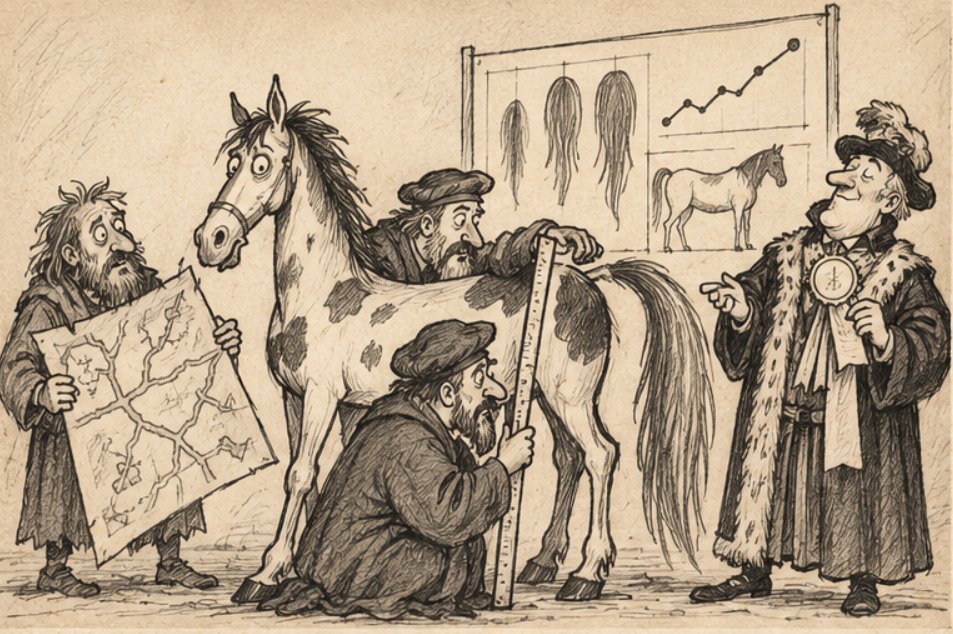
It soon became clear that different castles used somewhat differing rules for drawing up maps, and to solve the problem a special court service for unification was created. Since direct study of the road network demanded too much time, and sending cartographers to distant margraviates was expensive, the service decided to make use of indirect indicators, and after lengthy research it was established that the longer a piebald horse's tail, the greater the distance it is able to run, and hence the less often a messenger needs to stop to rest and ask the way.
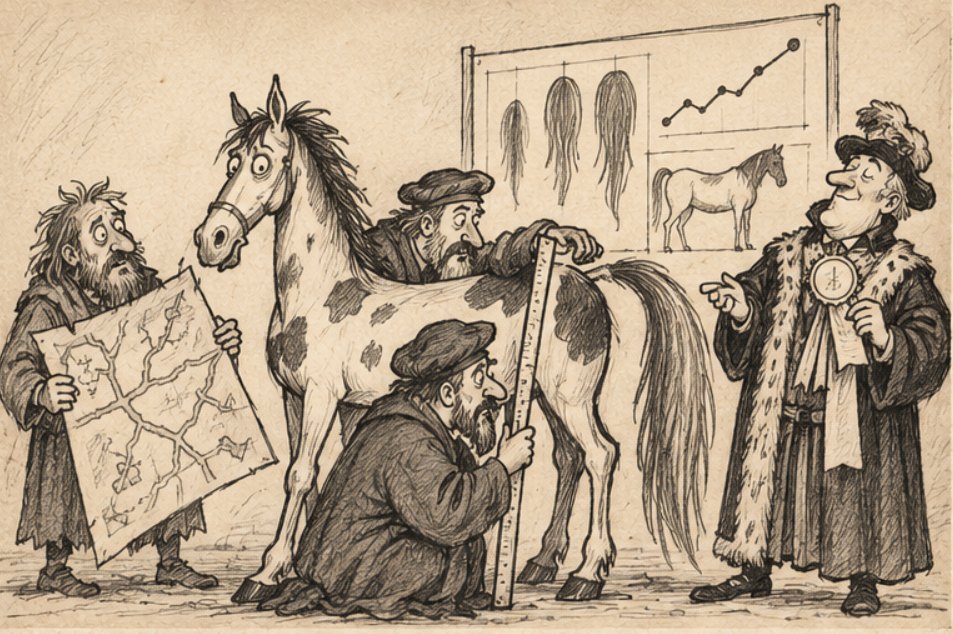
The methodology was recognised as scientifically grounded, since in the course of the trials the horses with the longest tails did indeed cover the greatest distance, although nobody paid attention to the fact that messengers with short-tailed horses were often sent along old, broken roads. On the basis of the results obtained, the service drew up a single standard for the placing of signposts, tying the distance between them to the average tail length of a piebald horse, and to monitor compliance it ordered that tails be measured monthly in all the royal stables.
When one of the cartographers timidly inquired how exactly the length of a tail affected the correctness of road maps, it was explained to him that he was thinking in outdated categories and did not understand the interdisciplinary approach. In the following quarter the average tail length rose by eighteen per cent and the productivity of the service reached a historic high, which testified to the stability of the methodology introduced and the need to develop it further. Since every commission for assessing the length of horses' tails had to include a treasurer, the methodology quickly received the necessary approvals and was recommended for execution.
The charter was received by all the castles except those which the messengers could not reach for lack of up-to-date maps; nevertheless, all the castles reported the successful adoption of the charter. The castles that were missed were absent from the old registry, and therefore officially did not exist, and entering them in the registry without up-to-date maps was impossible. The new court service declared the process of unification complete and wrote itself out bonuses for excellent work; the sovereign was not informed of this.
At the end of summer the keeper of the Mamsterdam castle received the latest tidings of the roads of the outside world and, as the instructions required, passed them on to the kingdom. Owing to an error in the castle's stables, messengers were dispatched along absolutely every known road of the outside world, including routes between foreign cities, ports and villages that no Yundexburg messenger had any intention of reaching, even for very good pay.
As a result, all the royal registries received roughly a thousand times more directions than usual. The cartographers honestly set about processing them, since they could not refuse a trusted source, and violating the principle of the unity of the road administration was forbidden.
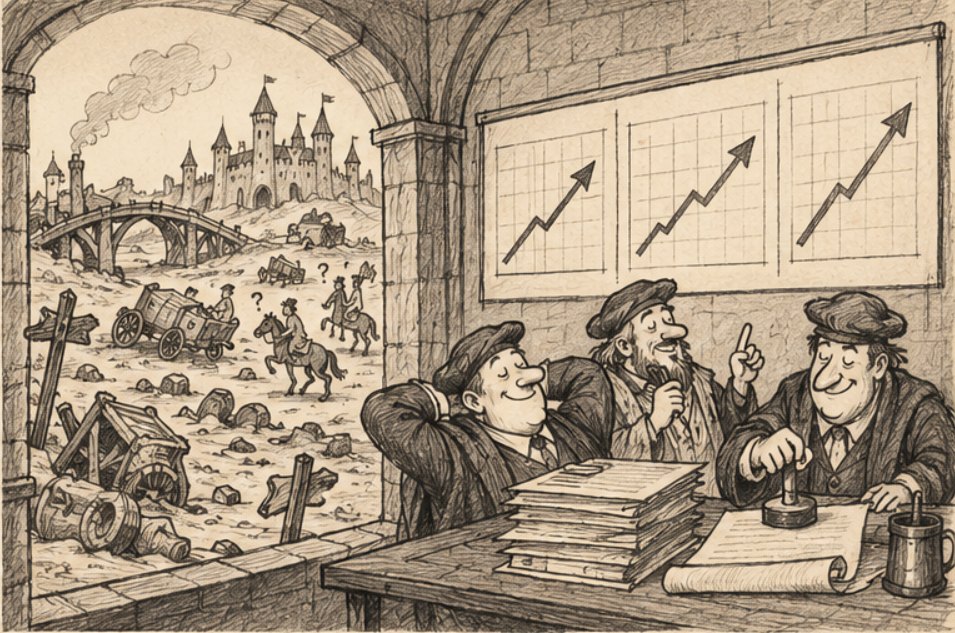
The tables filled with maps, the cupboards overflowed with scrolls, and the scribes began to spend more and more time looking for free space for new entries. The slower the cartographers worked, the more directions piled up, and the more they piled up, the worse the cartographers coped. Soon the road signposts were worn out from overuse, and after them the royal post, the search for documents and the trading services all came to a halt. The kingdom simply no longer knew how to use its own infrastructure.
The sovereign resolved to convene a crisis staff and sent a messenger for documents and an assessment of losses, to which the head of the royal post replied that he could not deliver letters, and the treasurer explained that he could not obtain information about the accounts. A dozen more margraves presented the status of their services, but little good came of it, and so Master Godfrid of Olden was summoned to court. Arriving by old paper maps, he went first of all to the Mamsterdam castle and demanded to see the construction plan, but the keeper could produce only a log of actions, a training certificate and a letter signed by the king attesting to the conscientious performance of his official duties.
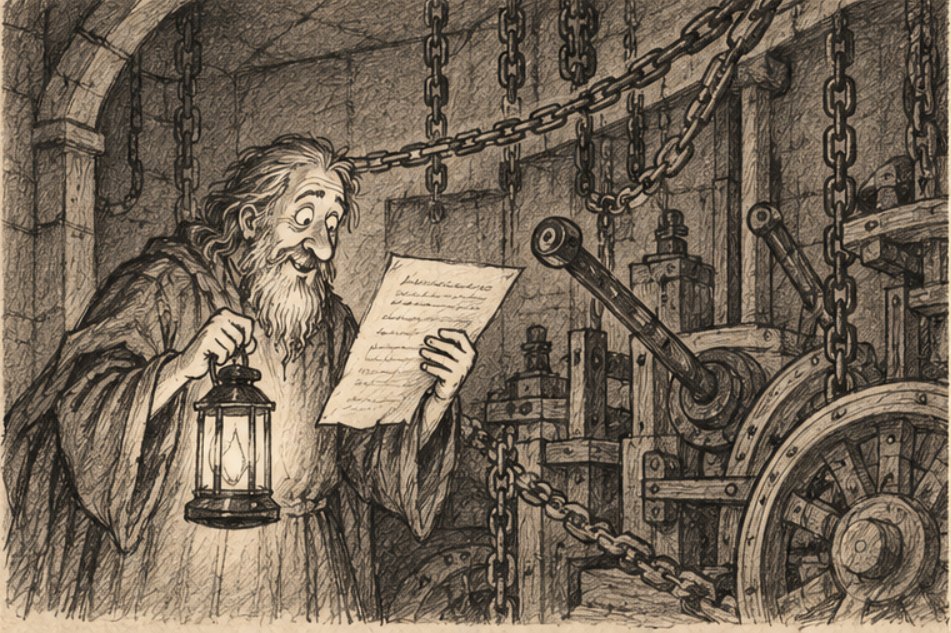
Although these documents were in perfect order, no understanding of what had happened was forthcoming, and so Godfrid asked to be shown the mechanism for passing on tidings. The mechanism was found quickly: through some misunderstanding it was connected by chains to several gates, went into the wall and vanished into a cellar where nobody had gone down for a long time. At the cellar entrance hung a board reading "Do not touch", and beneath it, in a small hand, was added:
"Dismantle after the release. If there is no release, do not touch. If it falls over, just restart the service and touch no more. Balthazar von Kludge, junior master. Written on the third day after the repository's init."
Godfrid reread the inscription and felt that somewhere in this castle there was a man with whom he could have worked splendidly. Balthazar had foreseen every possible turn of events, given no deadline, and left behind enough information for the next engineer to continue his work without having the slightest idea of what exactly was to be continued.
Alas, Balthazar had left the kingdom and, rumour had it, was designing mills in distant Krivengard on the banks of the Little Nevka. But he could not be found there either, since in the documents he appeared now as Balthazar von Kludge, now as Quickhand von Hotfix, and in one old order he was listed simply as "junior assistant, deployment department". Nobody understood the mechanism itself either, and since the chains that ran under the floor and were tied to the gates bore boards with the inscription "Do not touch", Godfrid ordered that everything be left as it was for the time being. He knew all too well how attempts to remove an old mechanism end, especially when nobody can explain what it is for.
Having got to the bottom of the cause of the accident, Godfrid ordered the passing of superfluous tidings stopped, the roads divided into independent sections, and work restored gradually. The royal engineers laboured all night, rewriting by hand the names on the signposts between the castles, and by morning the messengers were once again delivering letters and documents, and the merchants could carry on trading. That Godfrid had saved the kingdom was not mentioned in the inquiries, since saving the kingdom was not among the agreed criteria for evaluating the effectiveness of the crisis staff.
The commission established that the cause of the incident was a combination of unfavourable factors and a wrongly chosen breed of horse for assessing tail length, which suited everyone, since the horses were inviolable and fell within the competence of the whole kingdom, and therefore nobody could be answerable for the incident as a whole.
The keeper carried on working, having been promoted for the successful launch of the castle, and the chairman of the commission became an adviser on matters of reliability. By tradition, before closing the investigation, it was decided to reproduce the accident in the training yard, where a scaled-down copy of the castle was set up, three scribes were invited, maps were laid out and the transmission of road directions was started. But nothing happened: the scribes successfully processed all the entries, the signposts went on working, and the head of the trials reported that the incident could not be reproduced. The report particularly emphasised that the trials had been conducted successfully and the system had demonstrated resilience under load.
A junior cartographer tried to draw the commission's attention to the fact that three scribes were not enough for the test and that at least four should be used, but he was reminded that his task was painting road signposts, not assessing the quality of trials, and was sent on the training programme "Effective Communication in a Cross-Functional Environment".
Meanwhile the College of Cartographers was merged with the Department of Operational Excellence, and the new team was given the task of ensuring the resilience of the infrastructure, increasing the transparency of processes and developing a culture of shared responsibility. The duties were divided among six subdivisions, process owners were appointed and an interaction matrix was drawn up.
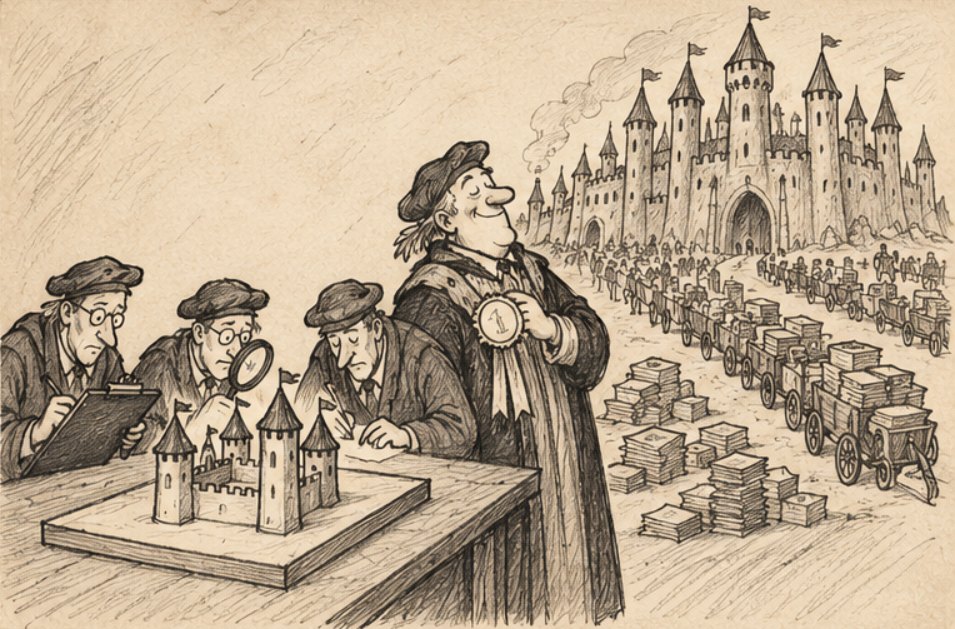
Soon the sovereign's counsellors decided to build yet another castle, to expand foreign trade once more, this time in the eastern direction. Remembering the problems with the building of the first castle, they included protection against an excessive number of road signposts in the specification, and scheduled the next stage of development for the next quarter, since in the current one all resources had been directed towards the achievement of strategic goals and bonuses.
At the end of the quarter Godfrid inquired whether the messengers had begun to deliver more letters, but it was explained to him that the delivery of letters depended on many subdivisions and therefore could not serve as a fair measure of the work of any single one of them. Hearing this, Master Godfrid sold his options, bought an old paper map and set off for the neighbouring kingdom. He already knew that in Yundexburg everything was working according to plan, all the responsible parties had been appointed, all the risks had been accounted for, and the only thing that could not be guaranteed was the average tail length of the new breed of horse.
The mechanism in the cellar of the Mamsterdam castle worked flawlessly, and nobody dared dismantle it, since its chains ran inside the walls, and the only man who knew where exactly they led was designing mills in Krivengard. The board still read "Dismantle after the release", but which release was not specified, and so it could be considered inessential, and the inessential, as you will remember...
All articles