
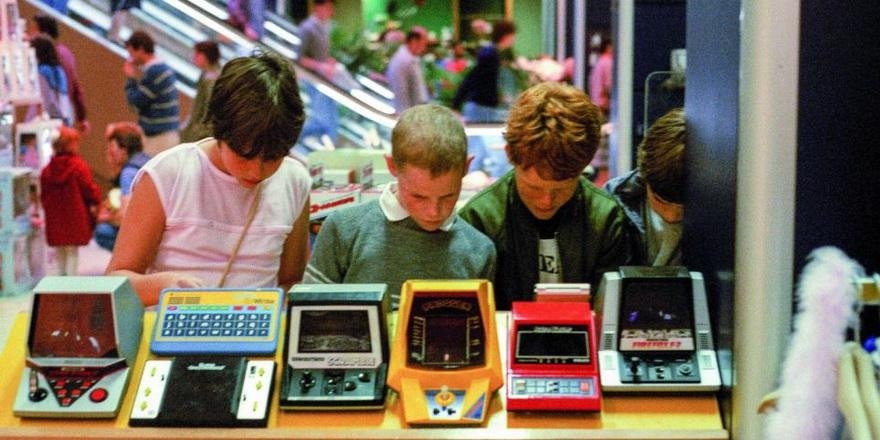
Electronic games (they'd become arcade, video and computer games much later) appeared not in cozy living rooms or even noisy gaming clubs. The first games were born in completely different places — in research labs, universities and the military bases of somebody's ministry of defense, where the military looked for new ways to use technology, to squeeze a few more efficiency proposals out of each unit of soldier. At the Kaneohe Marine Corps Air Station, soldiers were offered electromechanical games as early as 1949. To distract the lads at least briefly from grueling training and strict discipline, in the echoing barracks recruits spent hours intently twisting knobs and pressing buttons, trying to forget the hardships for a while, while the brass frantically dealt with the shortage of bromide on base.
Meanwhile, in the quiet of university buildings, among humming racks and stacks of punch cards, sleepy and overloaded students — the future luminaries of programming and proposers of new standards — turned huge, expensive mainframes into primitive game consoles. Instead of feeding punch cards into complex mathematical computations or models for research papers, these people wrote code for the first games. I can't blame them, because I myself, in the late '90s, used to sneak into the room where my father's computer sat and secretly launch SimCity or Caesar, or try to hack together a Battleship game in BASIC, guided by source code printed in some magazine, praying that the creak of the hard drive and the beep of the speaker wouldn't be heard by my parents.
So, in the shadow of science and military technology, out of curiosity, fatigue and the urge to play, one of the most powerful entertainment industries of our time was born — video games. A small respite for some, it soon became a mass cultural phenomenon and changed the world of entertainment.
Two completely different but equally significant segments of the video game industry began developing in parallel back in the 1950s. One of them grew out of the rattle of coins in bars and arcades, the other — from the dim glow of mainframe screens tucked away in university labs.
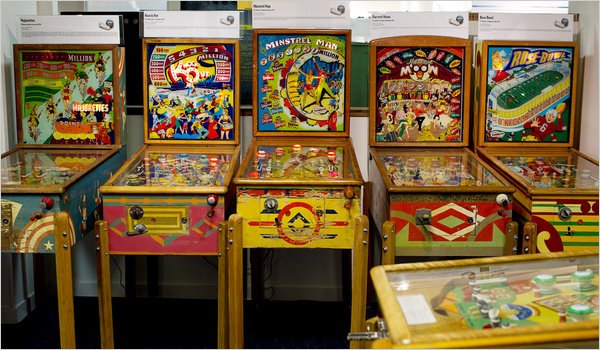
Games for coins
In 1951 the entrepreneur Marty Bromley, who ran the game rooms on military bases in Hawaii, noticed that soldiers were happy to spend their free time, and more importantly their honestly earned shekels, on electromechanical games and machines. That's how the company Service Games came into being, which over time became one of the giants of the game industry, now known as SEGA.
The new market segment quickly began to pick up steam: coin-operated machines with simple games started appearing in bars, malls and arcades. And in the 1970s a real arcade boom began — arcade halls, as they say, took off across all the states. It was right there that what we now call consoles and arcade game machines began. Versions of popular arcade games later migrated to home consoles, letting players keep competing at home in front of the TV — but many people didn't have one, which of course didn't much upset Marty and his comrades, for whom arcades were the priority. Otherwise we might not have ended up with twin-deck VCRs and Stallone films, but something more interesting.
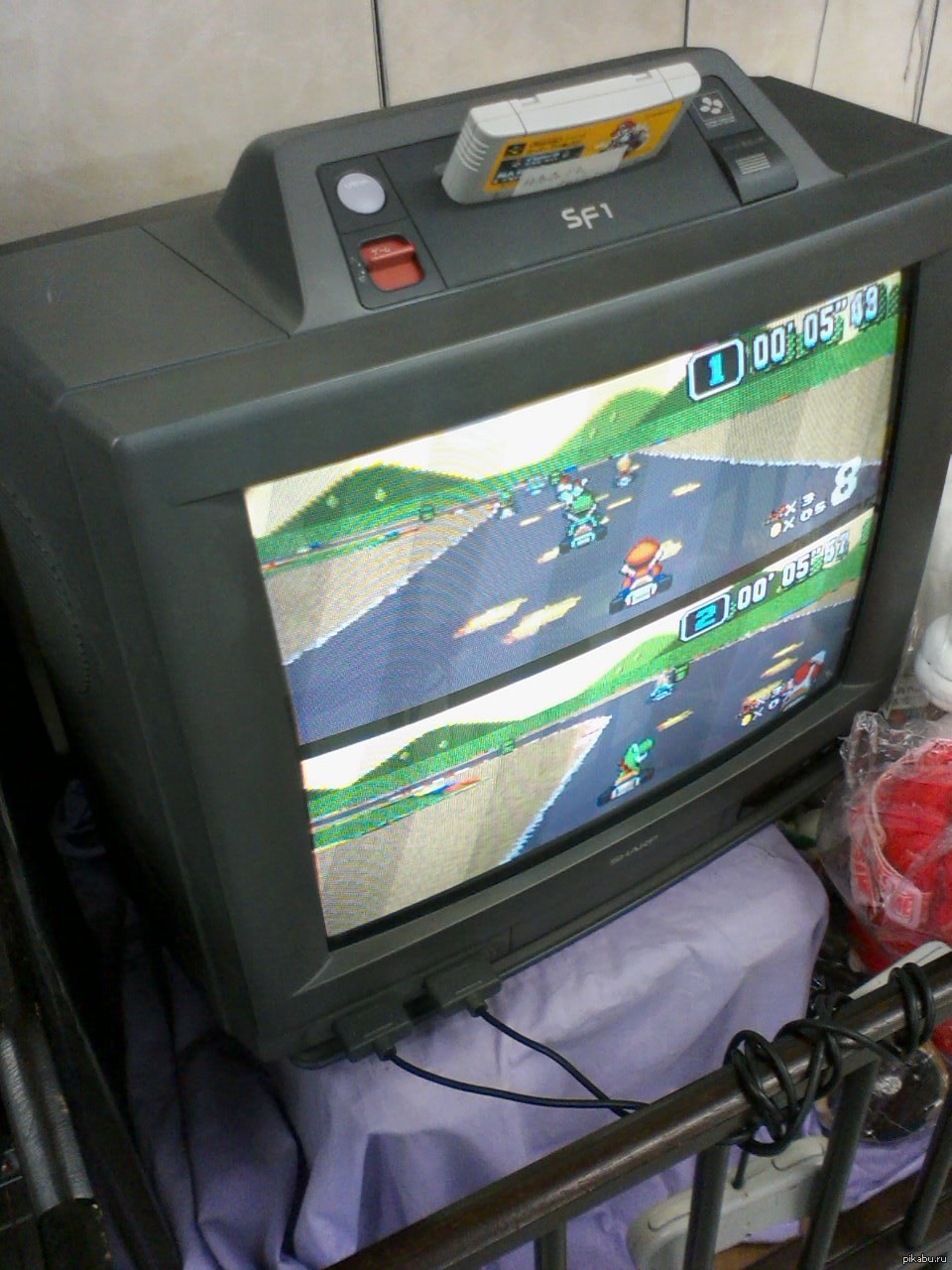
Games for programmers, by programmers
Meanwhile, in another part of game history, university students were also starting to master the new technologies — but not to entertain the public, rather for their own pleasure and in attempts to outdo their classmates. The first computer games (or should we properly call them mainframe games?) were born on night shifts, when the labs emptied out and the computing power of the university monsters could be used for more than complex mathematical calculations.
One such game, Spacewar!, created at the Massachusetts Institute of Technology, became so popular among students that it was ported to arcade machines. But games truly reached the masses only with the availability of personal computers — the massive mainframe was, after all, aimed at a different stratum of developers. That's when a new era began — the time of computer games, which no longer required either arcades or bulky cabinets.
Two directions of video games — arcade machines and computer creations — developed independently of each other and ultimately became the two pillars of a colossus of an industry, which today brings in billions of dollars and unites, by various counts, more than two billion players — i.e., with a high probability the person sitting across from you plays games.
Who are all these people?
Many companies and developers contributed enormously to the creation of games; you've probably run into their creations more than once — played cult titles and heard the names of studios that changed our idea of interactive entertainment, without knowing who stood behind them. Their work not only defined the path of the industry's development but continues to inspire modern studios, pushing them to search for new solutions, mechanics and ways of interacting with players. It's a shame the history of the computer game industry isn't taught at university — it tells a great many good stories about how NOT to do things, because these are stories not just about games but about practices of managing a team, a product, a company in the end. And all of it is tied to the specific cultural features of a country and the time period of development: a boring enterprise shop with Java 328 and decade-long lawsuits can't even imagine that such a thing is possible.
It's all video games
The term "video game" itself first appeared specifically in reference to arcade games; over time the word migrated into our homes and became a synonym for home consoles. There was also a clear division — games on PCs, which my classmate, with an important air, called "computer" games, and "console" games — but for some reason he came over to my place to play "Counter-Strike." Although today that boundary has practically vanished — all the big consoles, and most mobile platforms too, have merged in a fit of unification, and game engines have slathered it all in a thick layer of universality. Smartphones, VR headsets, cloud platforms — now you can call anything a "video game" as long as it beeps through a speaker, has a couple of buttons on a screen or controller, and lets you draw at least something on a screen!
And in a couple more years, who knows, we'll figure out how to bolt on neural-network rendering — and we'll wonder how it was ever possible to live without it! This evolution of the word itself reflects not only technical progress but also symbolizes the transition from arcade halls and clubs with their inimitable atmosphere to home and mobile games at arm's length.
Several companies trampled over everyone at the dawn of electronic games, staging a digital Wild West! Others started with anything but games (selling rice or military technology); still others tried, and keep trying, to capture every niche of the game market. Some remained only in players' memories, while others, like a phoenix, rise from the ashes again and again and bring a second "golden age" to the industry; some companies still haven't "left the game" — their logos glow on consoles. Ready to find out how Space Invaders was born from... a "laser gun," and how "Pac-Man" almost became a pizza?
Before video games appeared, the most popular arcade entertainments were electromechanical pinball machines of all kinds, shapes and colors. They were often placed in amusement parks, attracting people of all ages who held pinball competitions during weekend get-togethers. There were even separate pinball clubs and their own championship; with the arrival of arcade machines, such parks and clubs became even more popular. They were usually located near schools and residential areas, so on the way home after class, kids would bring a couple of quarters from their lunch money into the lair of Donkey and Diddy and stay there until evening, forgetting to eat and do their homework.
In 1956 David Rosen of Rosen Enterprises began importing coin-operated electromechanical machines and became the largest entertainment company in Japan. In 1964 Rosen Enterprises merged with SEGA, forming Sega Enterprises, which released the first Japanese export product — Periscope — on the American market. The high cost of shipping machines and U.S. tariffs forced American arcade owners to charge 25 cents per game, which corresponds to roughly 250–300 rubles per game today. Every imported arcade machine was hit with a 25% tariff, and on top of that the owner paid the state for land rent if they were going to place it in public spaces — all of which raised the price of a single unit to 1500–2000 USD. Depending on the model and configuration, in today's money that's about 10–20k. For comparison, the price of an ordinary pinball machine rarely exceeded 300 bucks. Nevertheless, the quarter quickly became the standard for arcade machines. In 1969 Sega was acquired by Gulf & Western, but in 1984 David Rosen, together with his partner Isao Okawa, bought it back. The deal was worth 38 million dollars.
Some games became real technological breakthroughs for their time, in spite of technical limitations, opening up new horizons in genres, gameplay and development methods that nobody had even thought about before. Others became so popular that they won over a wide audience and remain playable to this day, and now and then they get pulled out of the dusty closet and re-released for consoles, PCs and phones under various sauces.
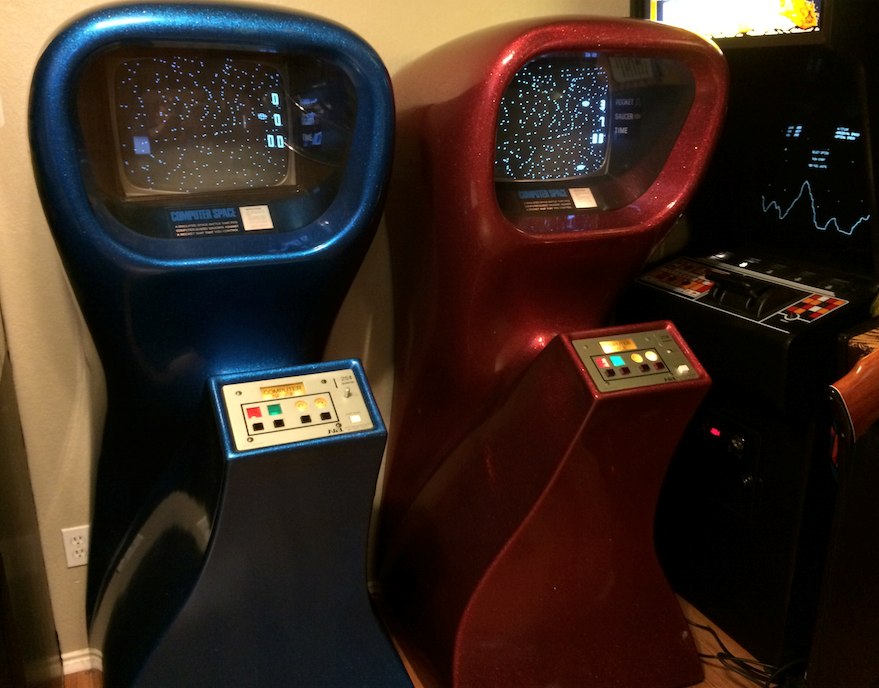
Computer Space
In 1961 MIT student Steve Russell created a real sensation — Spacewar! Though it was a sensation only for students, of that very same MIT. On the university's mainframe he brought to life the first interactive computer game, which instantly gained a host of fans among his classmates. I don't know how Steve managed to pull it off. All attempts to run unaccounted-for software, be it games or a calculator, on the ordinary university machines that stood in the lecture halls of ITMO were harshly punished by the admins and usually ended with a trip to the dean's office. Apparently my classmates' sweaters weren't long enough, and the herd of deer too small, falling short of the admin's, though craftsmen were of course found anyway.
How Space Invaders was born from… a "laser gun" (a tall tale)
Picture the late 1970s: the world of technology was only just beginning to master the magic of video games, while the imagination of sci-fi writers had already given birth to lasers, gravity guns and plasma cannons. It all started with a simple but bold idea — to create something like a laser gun that could defend humanity from an approaching threat.
Inspired by images of futuristic battles and space combat, developer Tomohiro Nishikado decided to bring to life the dream of a powerful defender of the earth with a big gun. This "laser gun" became the central element of the game.
So, from the idea of a laser weapon that was supposed to repel a threat from outside, Space Invaders was born and later evolved into Galaxian.
But the real breakthrough happened when Nolan Bushnell, the future founder of Atari, saw Spacewar! and realized that this elitist game — meaning one available only to a narrow circle of scientists and students — could be transformed into something that would light an inextinguishable fire of game development in the hearts of ordinary people. A pompous phrase, of course — and also to earn himself a couple of shekels. So the idea was born to adapt Spacewar! into a standalone arcade machine that could be installed in public places.
Bushnell named his version Computer Space and sold the idea to Nutting Associates in 1971. The game offered simple but active gameplay: the player tried to shoot down a flying saucer, fighting a virtual space duel. Although by modern standards the concept seems primitive, at the time nobody could offer anything like it. CS was the first step in transforming the closed world of university experiments on the path to the arcade revolution.
Despite Computer Space's rather modest sales, it was Bushnell who laid the foundation for a whole era. In 1978, when technology had made a giant leap forward, the company Cinematronics released Space Wars — a new, more advanced arcade interpretation of the original game.
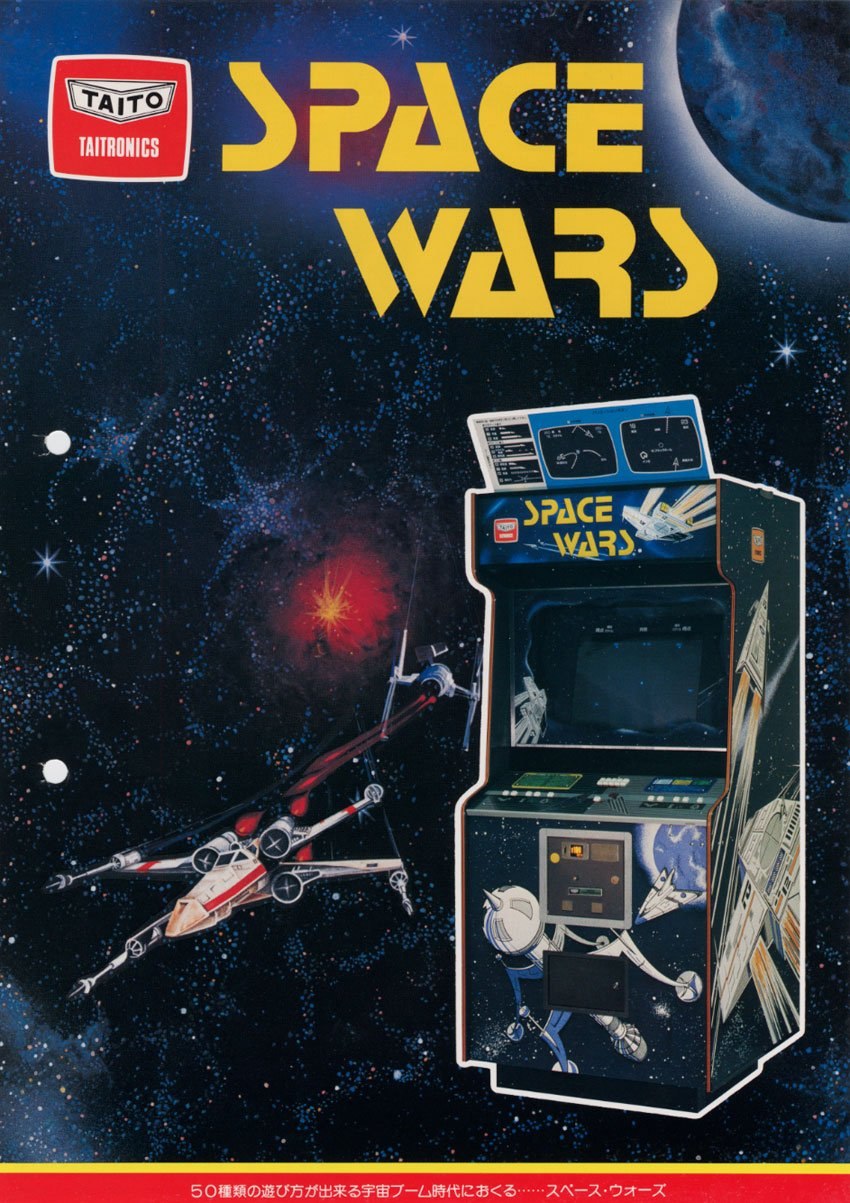
Space Wars' new graphics and sound effects revived interest in the ideas Steve Russell had laid down. Every couple of years, on various devices, yet another remake of that very first game flickers by — it really will be a hundred years old before long, or rather 70-something.
Atari
After Computer Space, Bushnell, together with his partner Ted Dabney, founded the company Atari — which comes from the word for the Japanese board game Go and means roughly: "Careful! My next move could be dangerous for you" — analogous to "check." After lengthy court battles with Magnavox over the rights to the first successful video game Pong, and accordingly over who'd collect the royalties, Atari became the most productive company in the arcade business, releasing arcades such as Asteroids, which became a video game hit and forever made the name Atari a synonym for arcade machines.
What does Pong have to do with it
The beginnings of this game are traced to 1958, when Willy Higinbotham, a physicist at Brookhaven National Laboratory in New York, demonstrated his table-tennis game (Tennis for Two) on an analog computer. This game was a primitive predecessor of interactive video games.
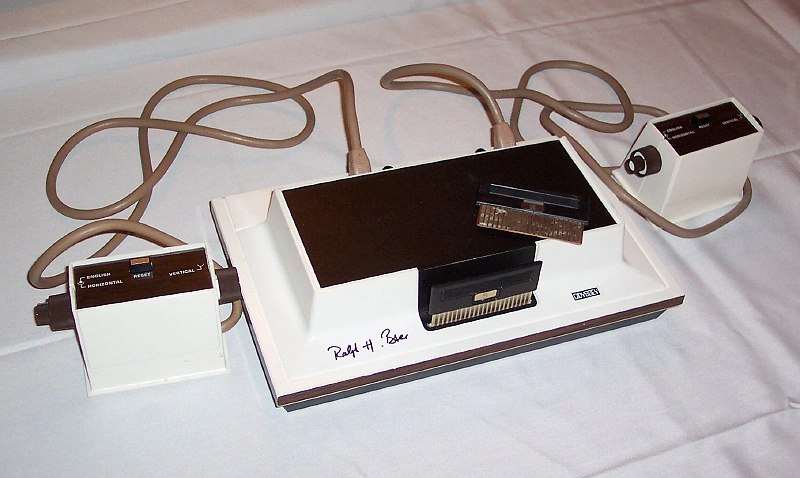
Almost a decade later, in the 1960s, Ralph Baer, an engineer at Sanders Associates, began developing ideas for an interactive television "table tennis" game. In 1968 he patented his design, and in 1970 he struck a deal with Magnavox, which licensed his idea. This collaboration led to the creation of the Magnavox Odyssey, the first home game console, released in 1972, which included Baer's "table tennis" game — the first example of a home competitive video game. Odyssey shipped with a simple ball game using paddles, similar to Tennis for Two, but on a TV screen.
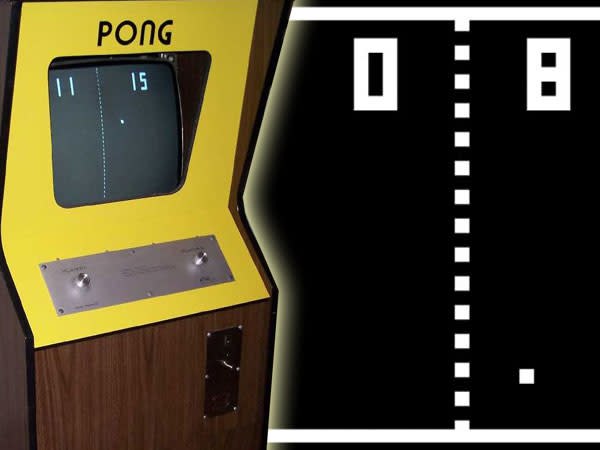
Meanwhile, in California the company Atari released its first arcade game in 1972 — Pong, developed by the company's engineer Al Alcorn. The goal of the game was simple: players used paddles to hit the ball and tried not to miss it in order to score points. The controls consisted of a knob that turned in two directions. Pong quickly became the first successful arcade and gained enormous popularity.
However, Pong's success led to legal claims from Magnavox, which argued that Atari had copied the idea of Tennis for Two. In 1972 Magnavox sued Atari, accusing it of stealing the game concept. The case was settled amicably, with well-known physical games being placed outside copyright, but it set a precedent for future litigation over copyright use in video games.
In 1978 Nolan Bushnell left the company for personal reasons with a golden parachute of about $15 million in compensation, which was a huge sum at the time, and started several new projects, including the creation of new startups and expansion into other business areas. Atari passed to the large media giant Warner Communications, marking a new era for the company, which began paying far more attention to the commercial aspects of game development — marketing and business development — than to the games themselves. Under Warner's management the emphasis shifted to expanding the business through console systems, which pushed arcade machine development into the background.
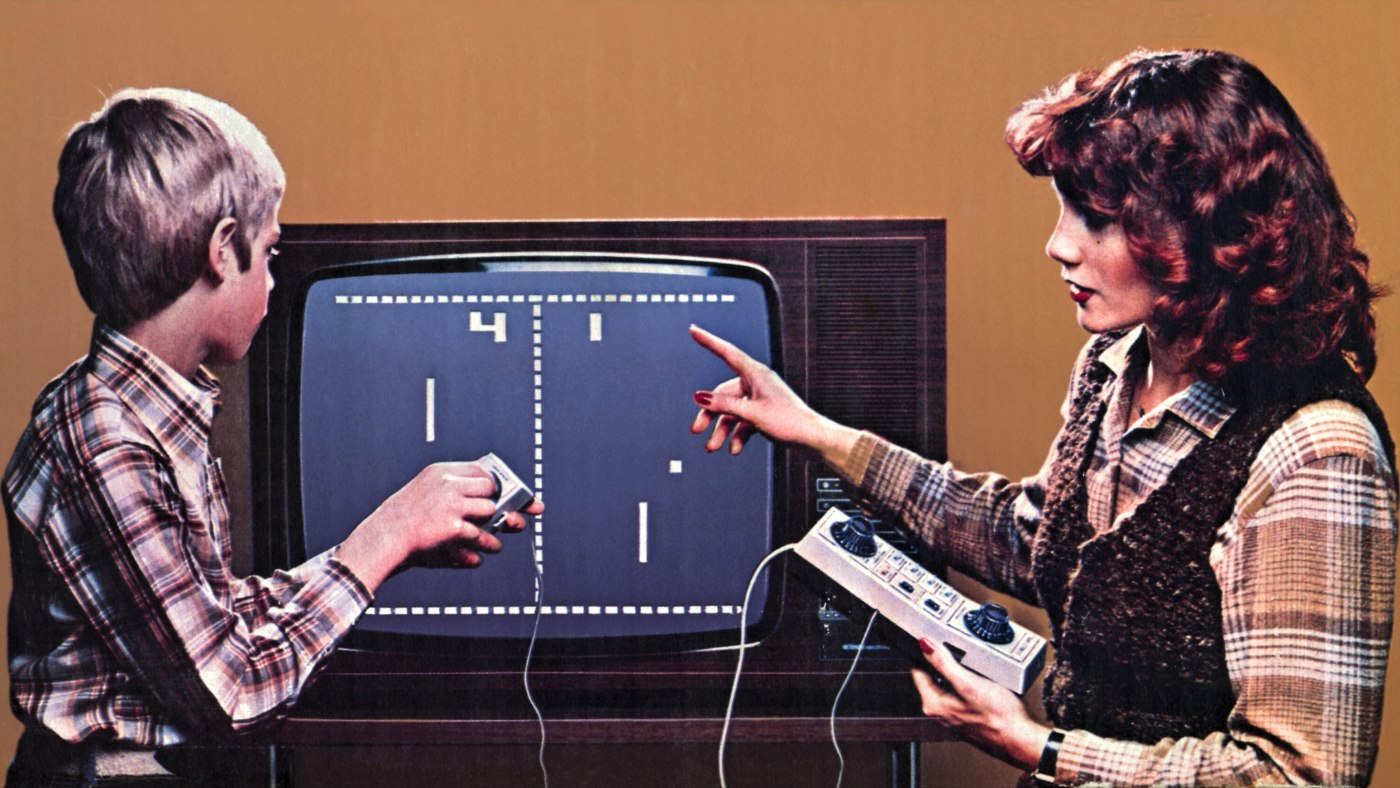
Arcade machines by Atari (lots of pictures)
1972 – Pong – The first commercially successful video game, which kicked off the whole industry.
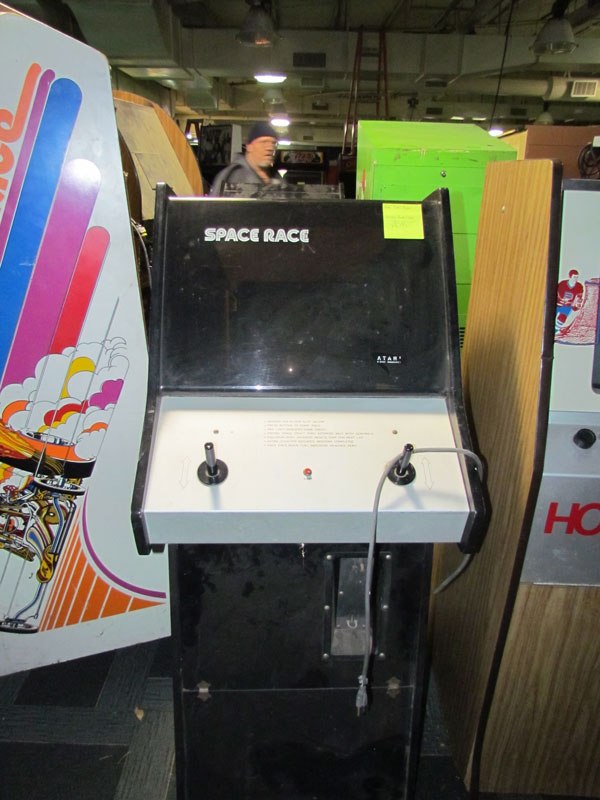
1973 – Space Race – A spaceship race
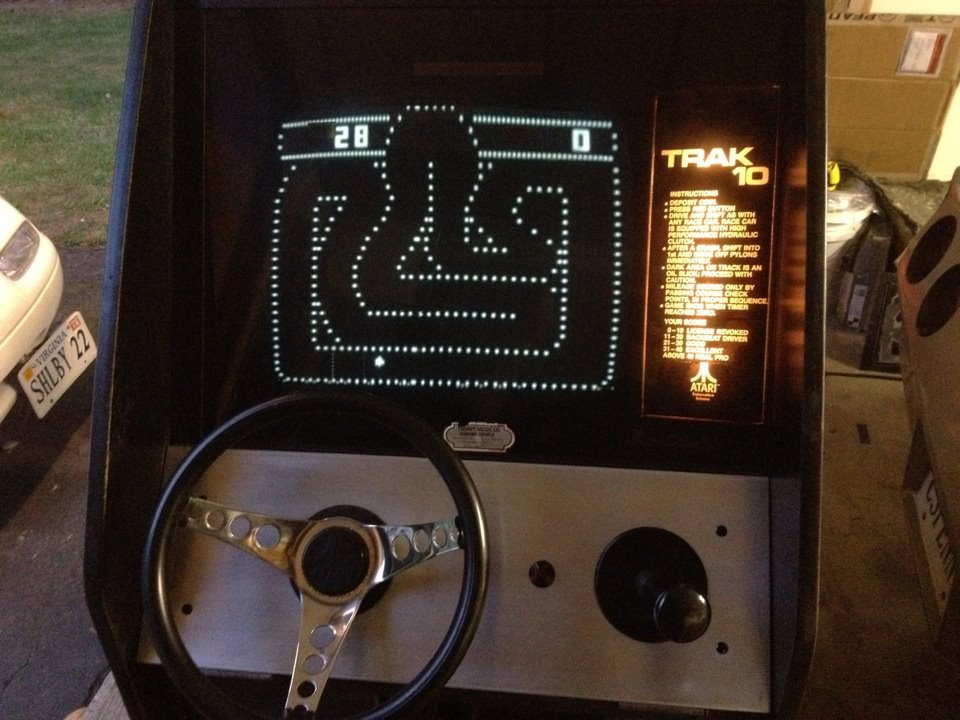
1974 – Gran Trak 10 – The first arcade racing game with a steering wheel and pedals.
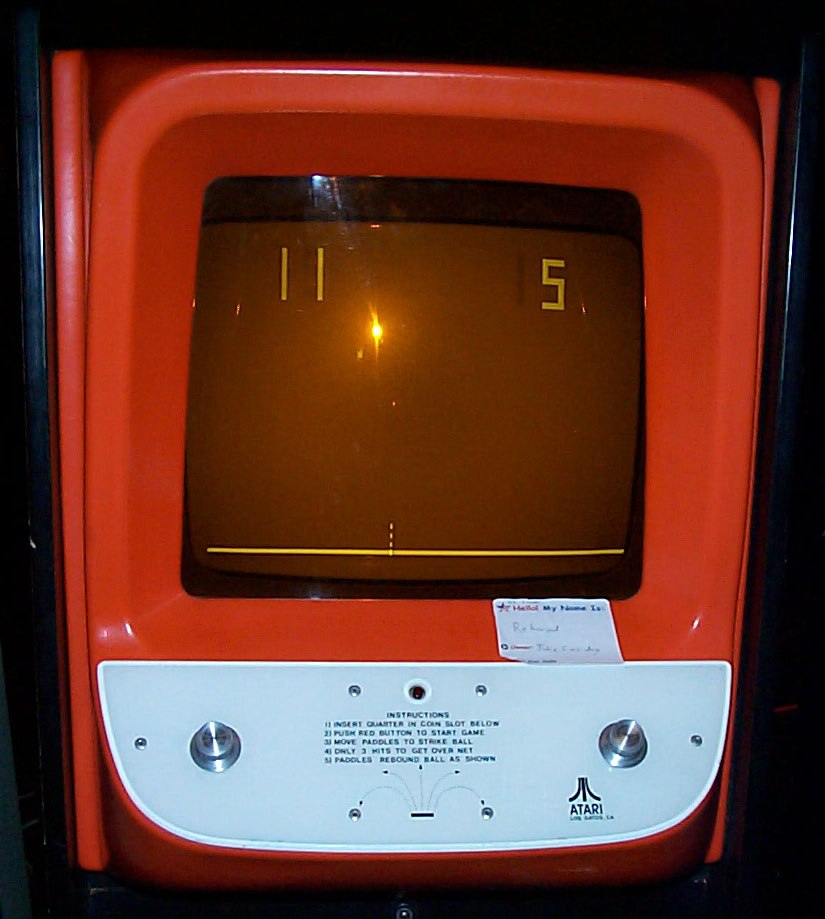
1974 – Rebound – Resembled Pong, but with a ball that bounced off a wall.
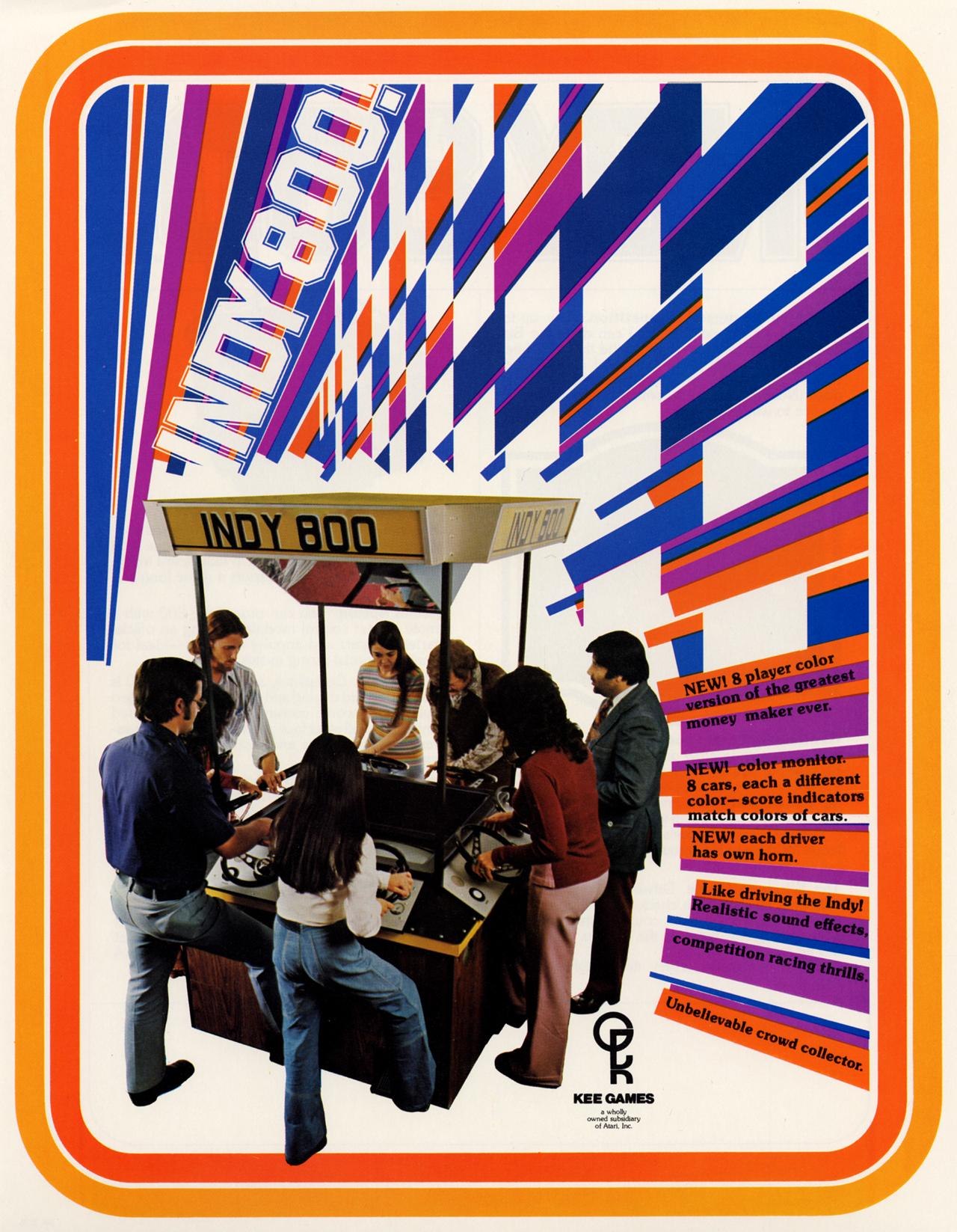
1975 – Indy 800 – Top-down car racing for eight players.
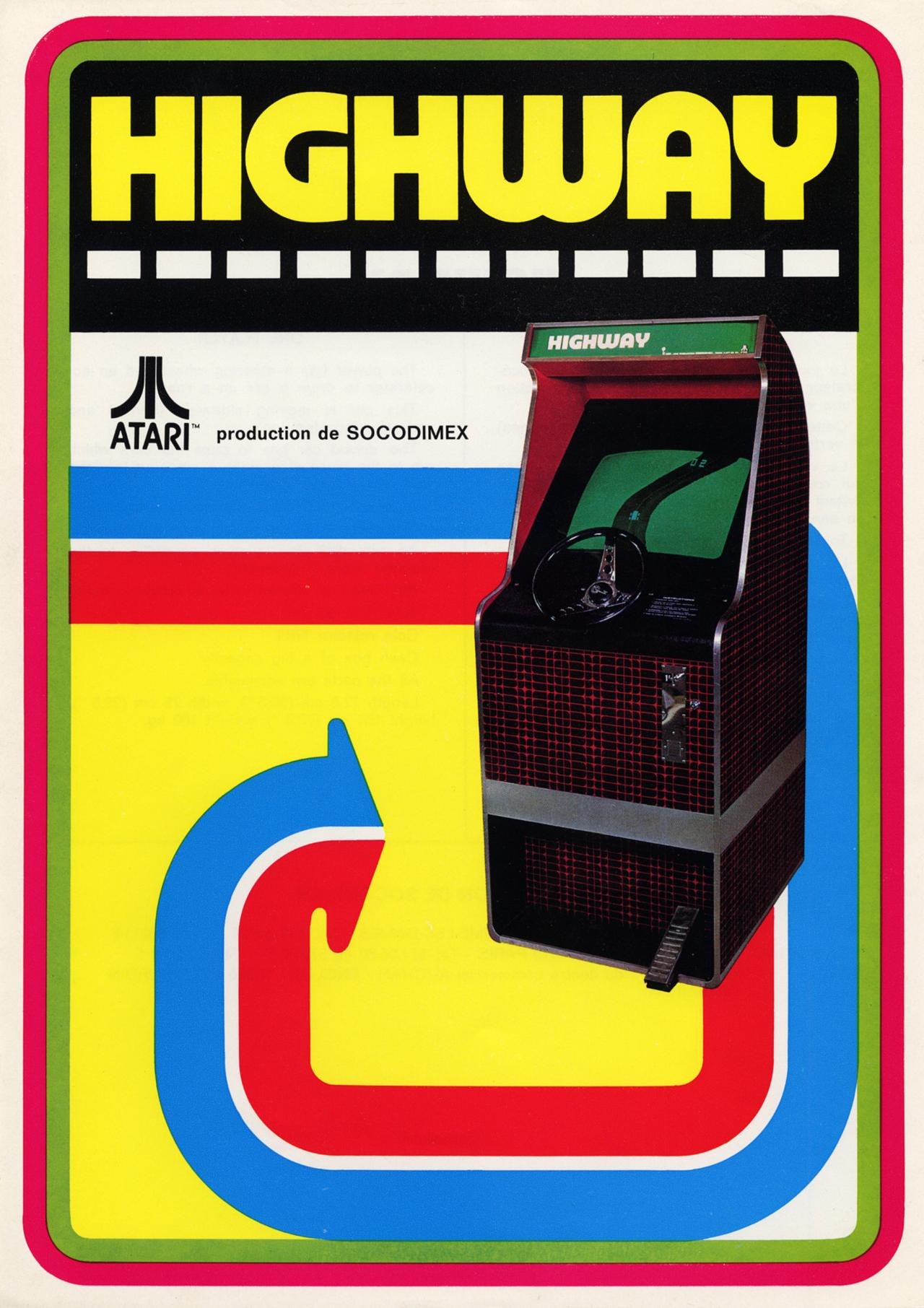
1975 – Hi-way – A top-down race.
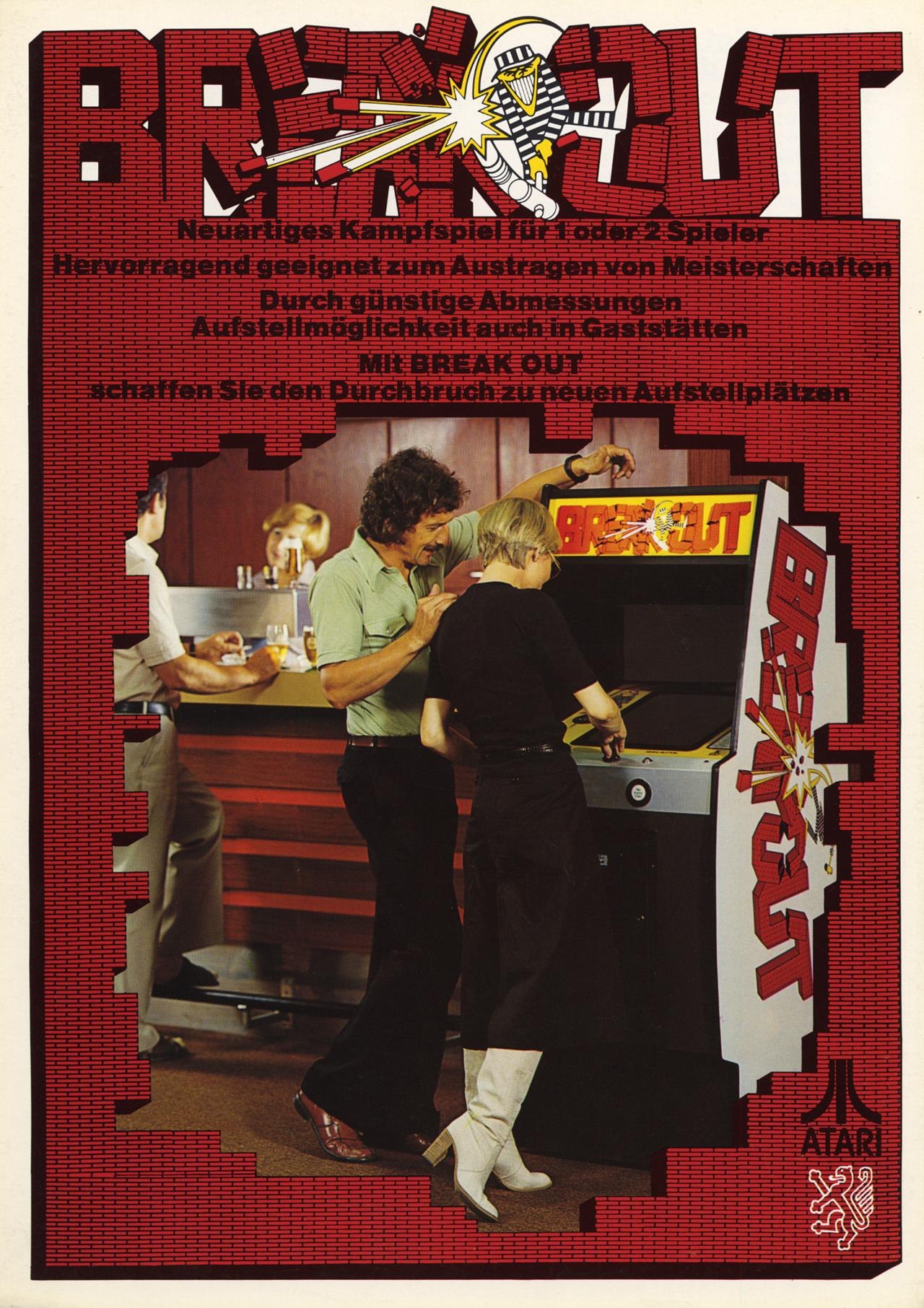
1976 – Breakout – One of its developers was Steve Wozniak, co-founder of Apple.
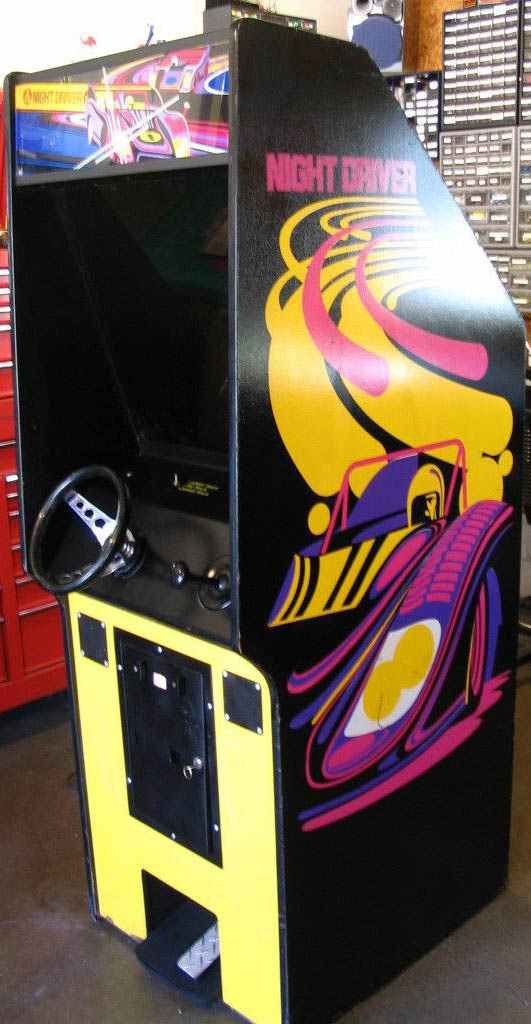
1976 – Night Driver – One of the first games with a driver's-cabin view.
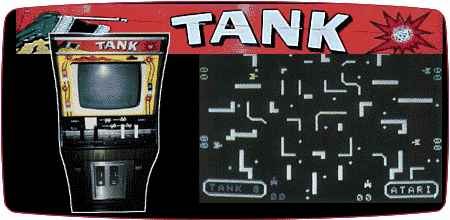
1976 – Tank (developed by Kee Games, Atari's subsidiary studio)
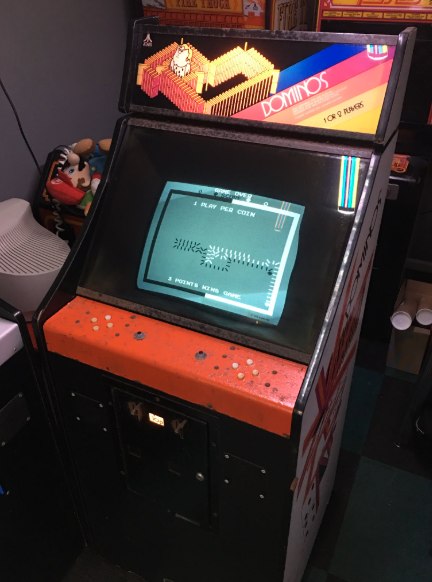
1976 – Dominos – A variation of Breakout, but with domino tiles.
1977 – Canyon Bomber – Players drop bombs on objects in a canyon.
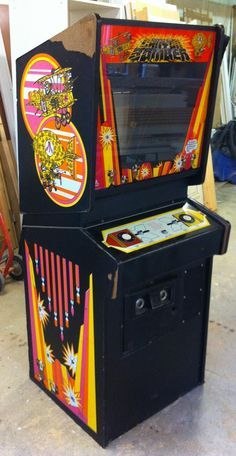
1978 – Football – One of the first video games simulating American football.
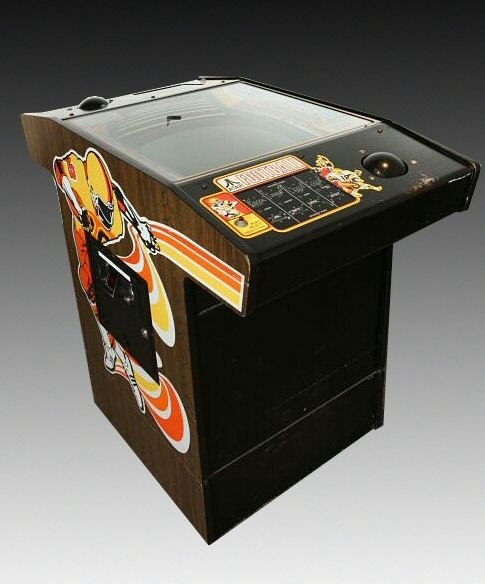
1978 – Lunar Lander – A lunar-module landing simulator
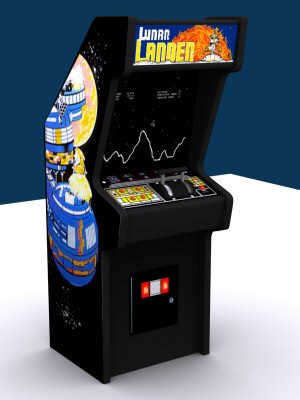
1979 – Asteroids – One of the most popular arcades of all time.
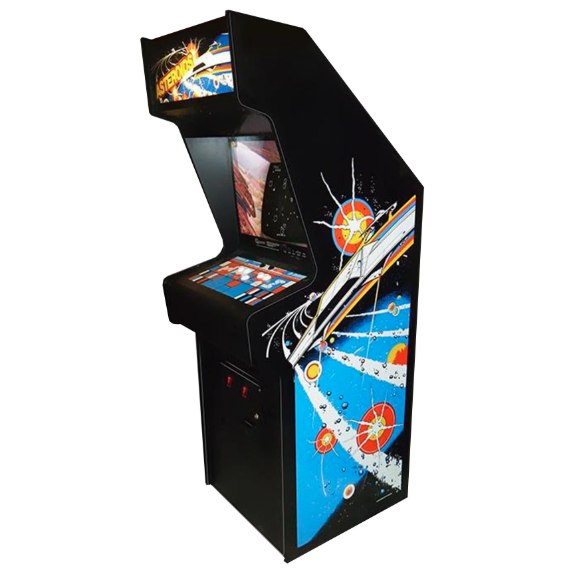
1979 – Basketball – Atari's first basketball arcade.
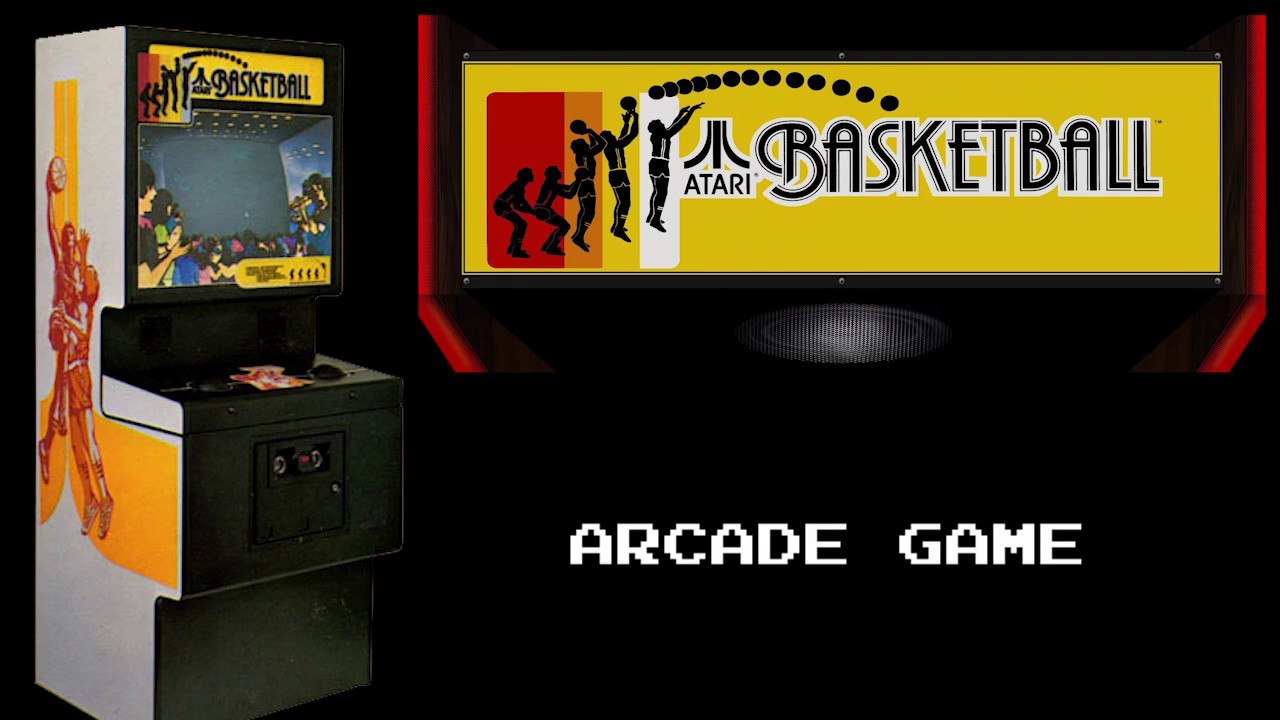
1979 – Soccer
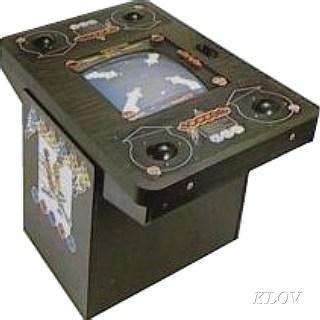
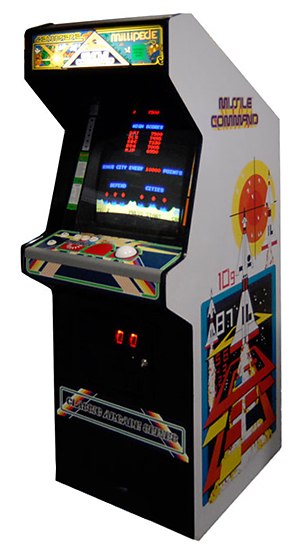
1980 – Missile Command – the player must defend cities from missile attacks.
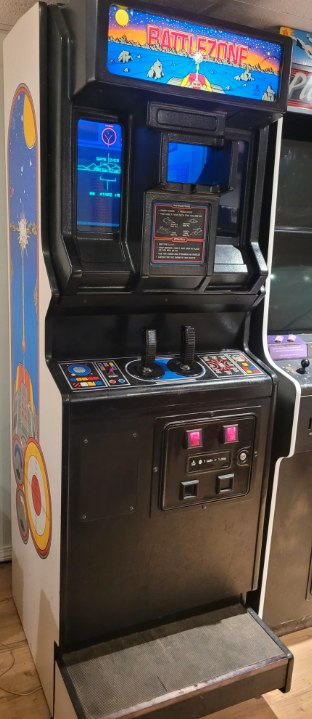
1980 – Battlezone – a shooter with vector graphics, a military tank simulator.
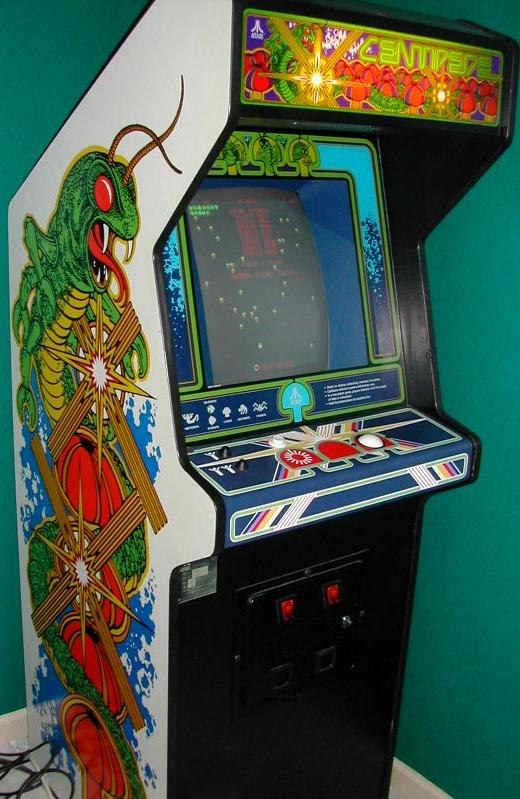
1980 – Centipede – A classic arcade where the player fights a centipede moving down the screen.
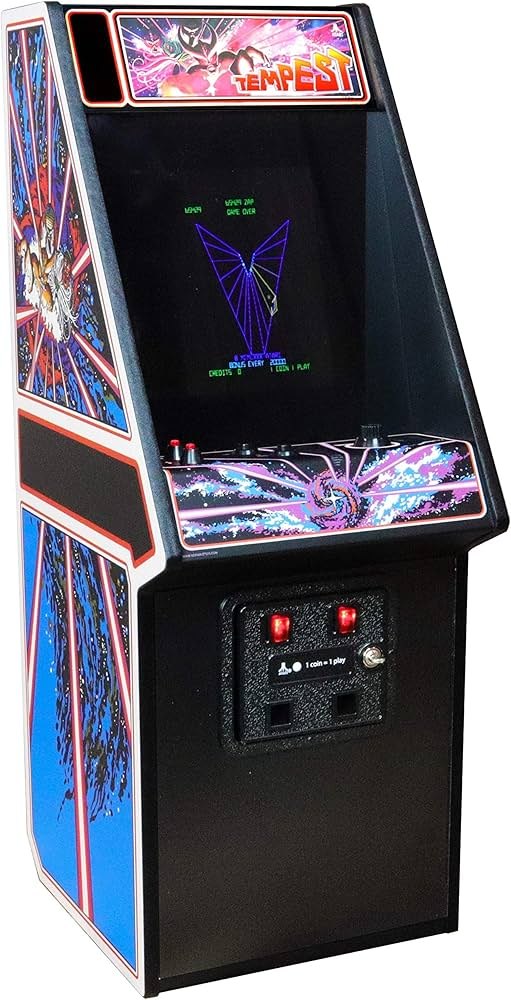
1981 – Tempest – One of the first games with "level selection" — the player could start from harder stages. A special rotating controller (a spinner) was used to steer the ship in pseudo-3D.
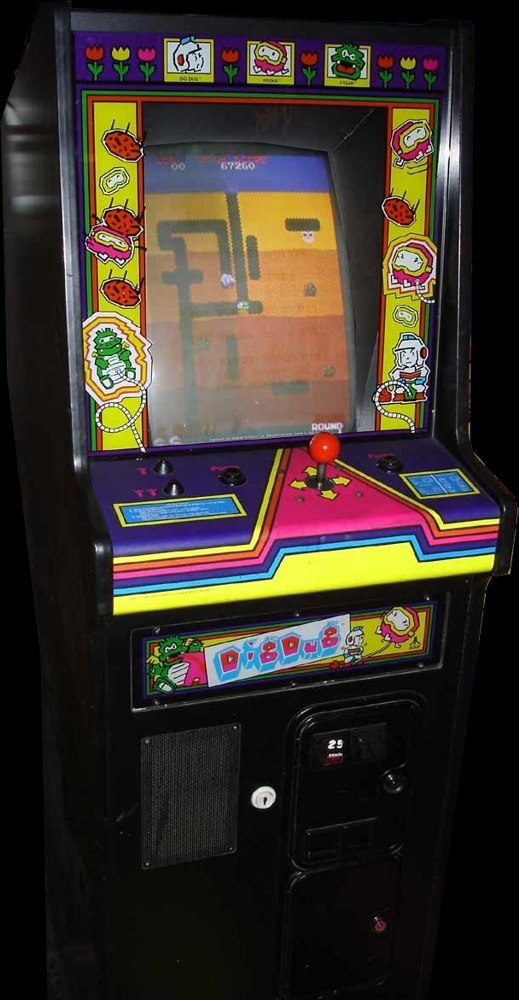
1982 – Dig Dug – you have to dig tunnels and destroy enemies.
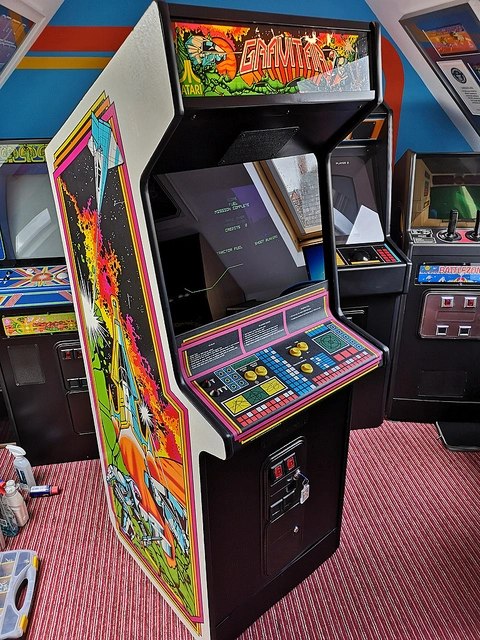
1982 – Gravitar – An advanced arcade with gravity, a more complex take on Lunar Lander.
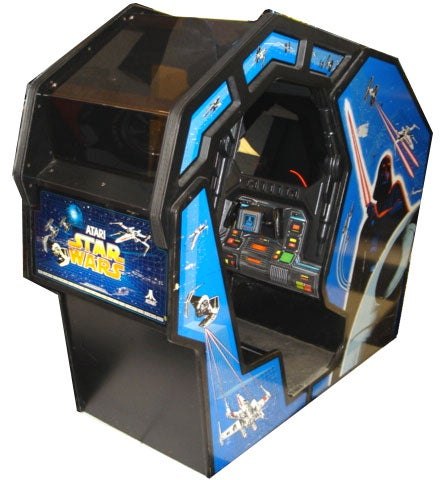
1983 – Star Wars – An arcade game based on "Star Wars" with vector graphics; you steer an X-Wing.
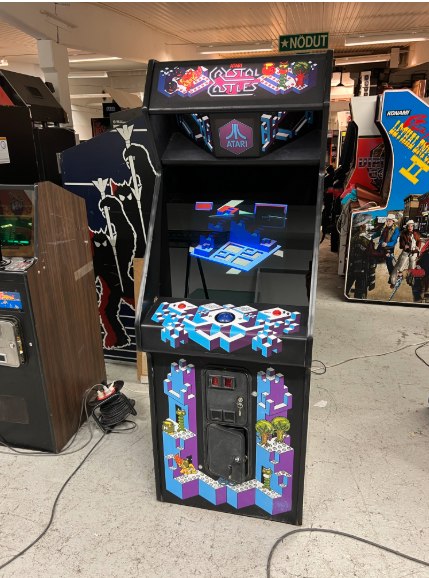
1983 – Crystal Castles – A game with isometric graphics where the player controls a bear named Bentley and collects crystals.
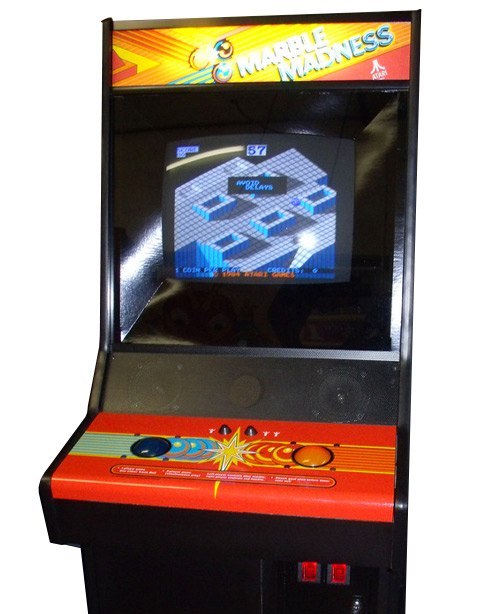
1984 – Marble Madness – An arcade with ball physics, controlled with a trackball.
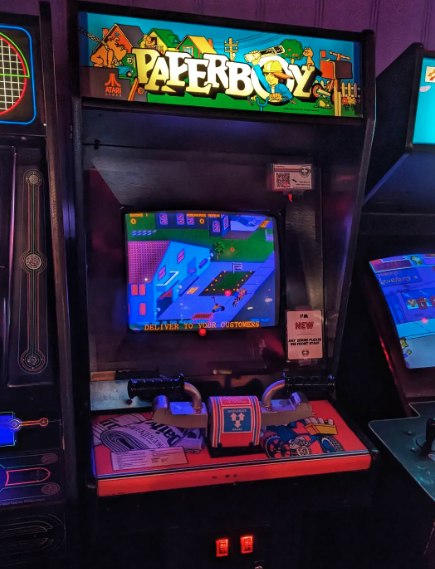
1985 – Paperboy – you have to deliver newspapers to houses and avoid obstacles.
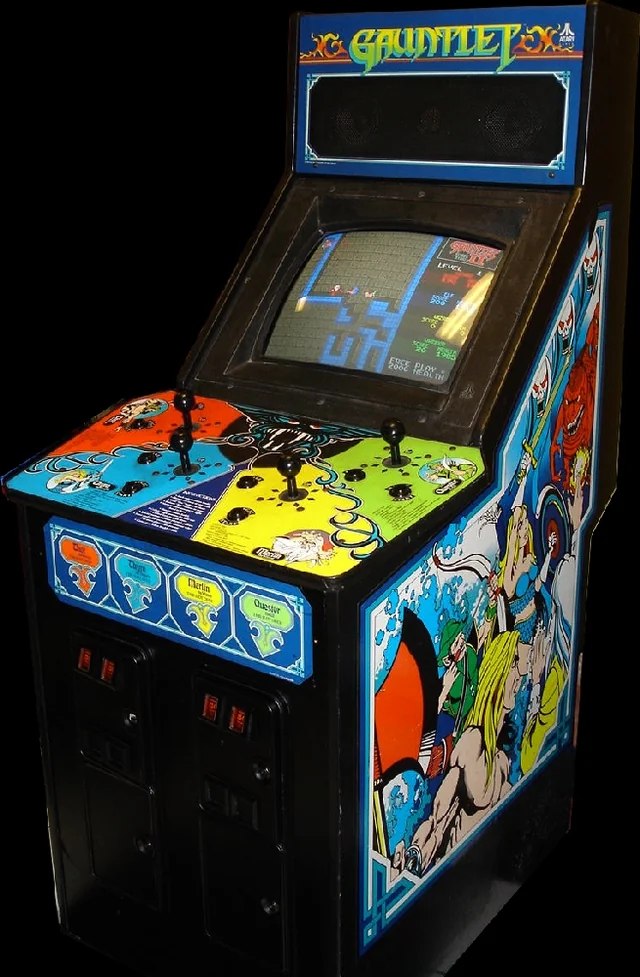
1985 – Gauntlet – One of the first multiplayer (up to 4 people) cooperative dungeon crawlers.
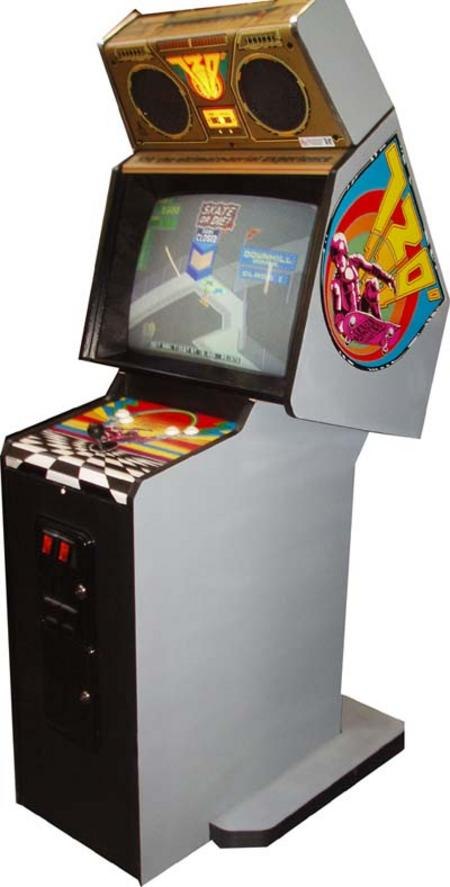
1986 – 720° – The first arcade game about skateboarding.
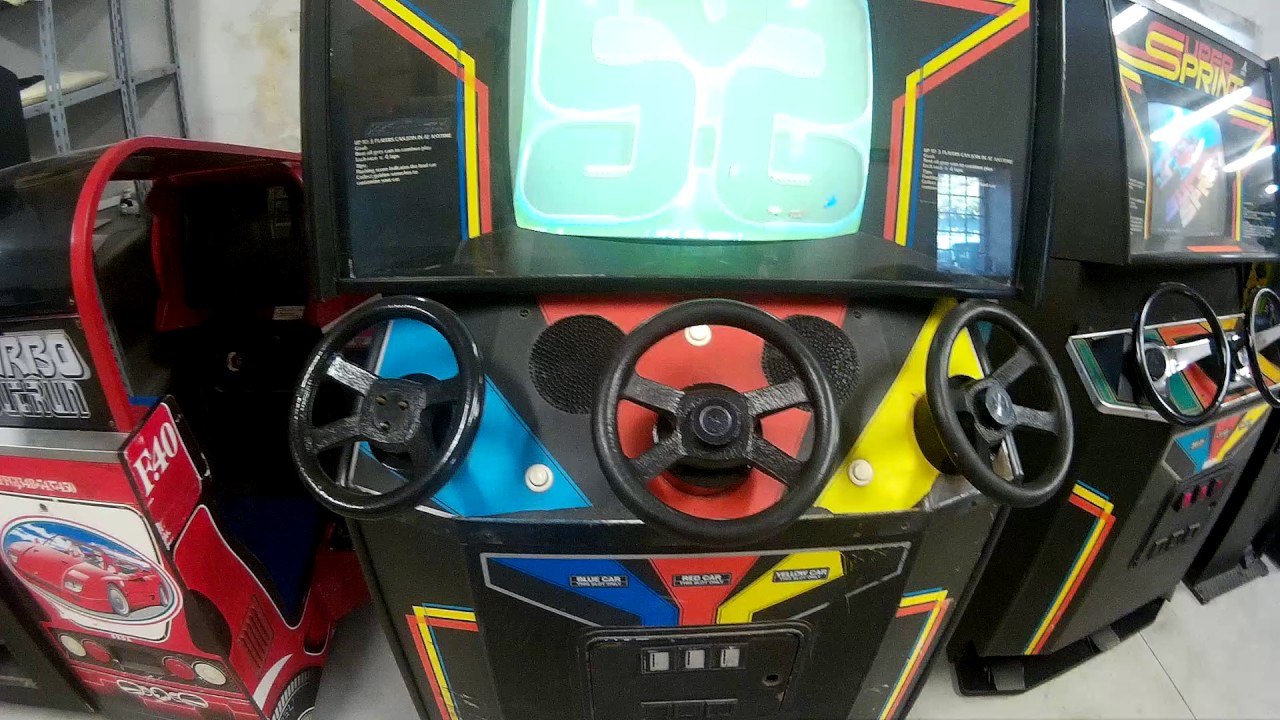
1986 – Super Sprint – A classic top-down racing arcade for three.
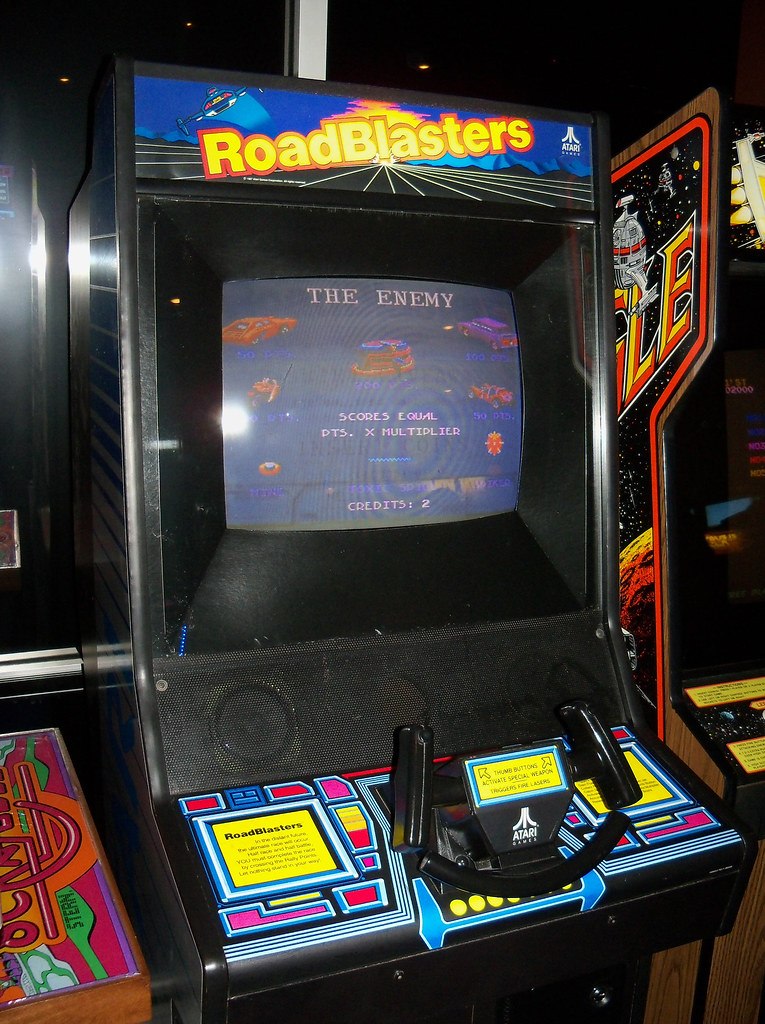
1987 – RoadBlasters – Survival racing.
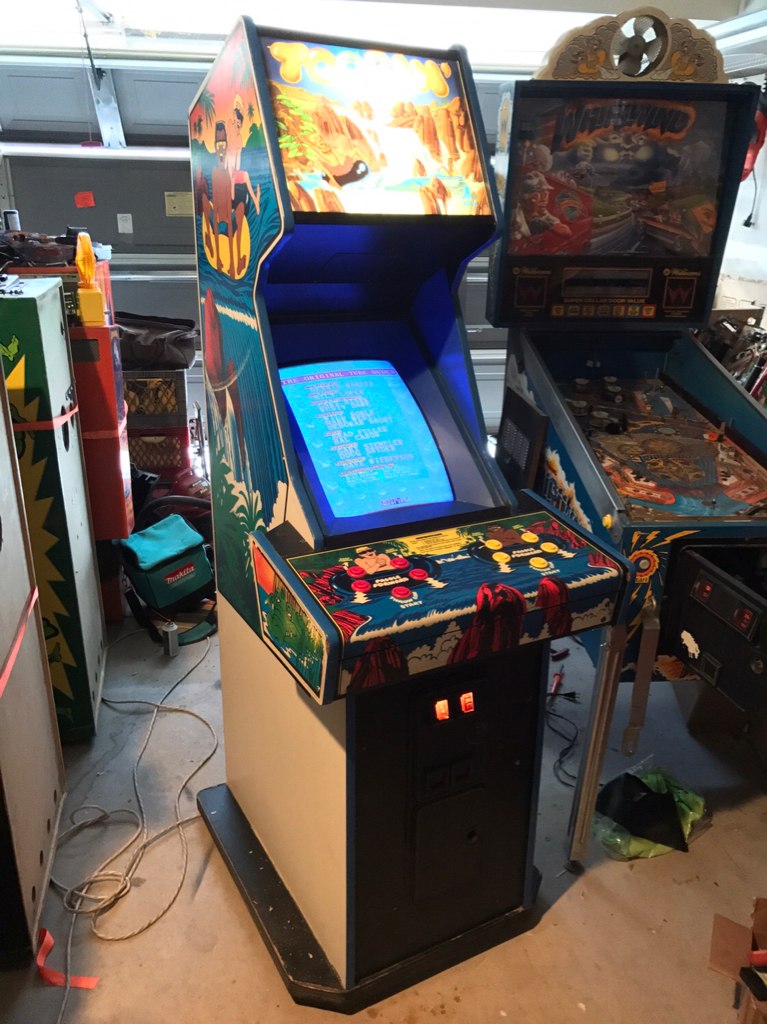
1988 – Toobin’ – the player controls a person in an inflatable ring floating down a river.
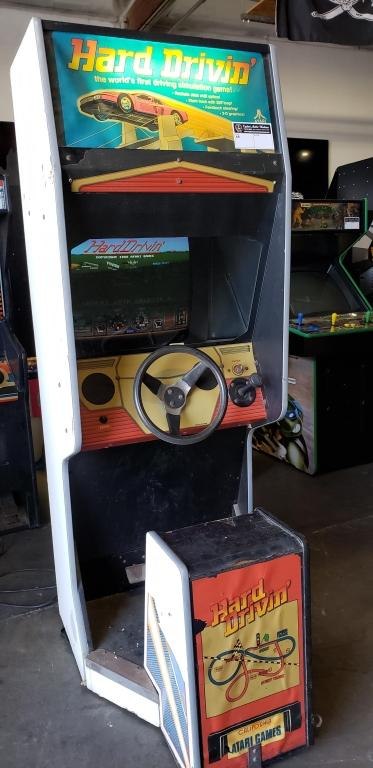
1989 – Hard Drivin’ – One of the first arcade games with 3D graphics and car physics.
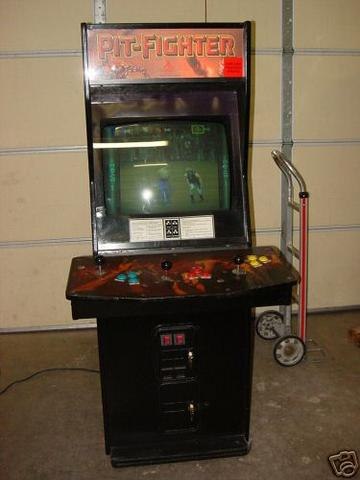
1990 – Pit-Fighter – One of the first fighting games with digitized sprites of real actors (a predecessor of Mortal Kombat).
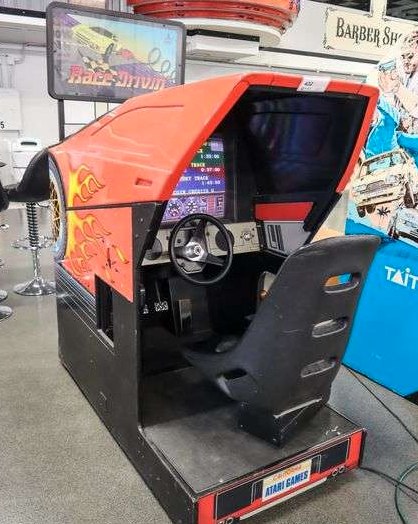
1990 – Race Drivin' – A sequel to Hard Drivin’, an improved 3D race with tracks and stunts.
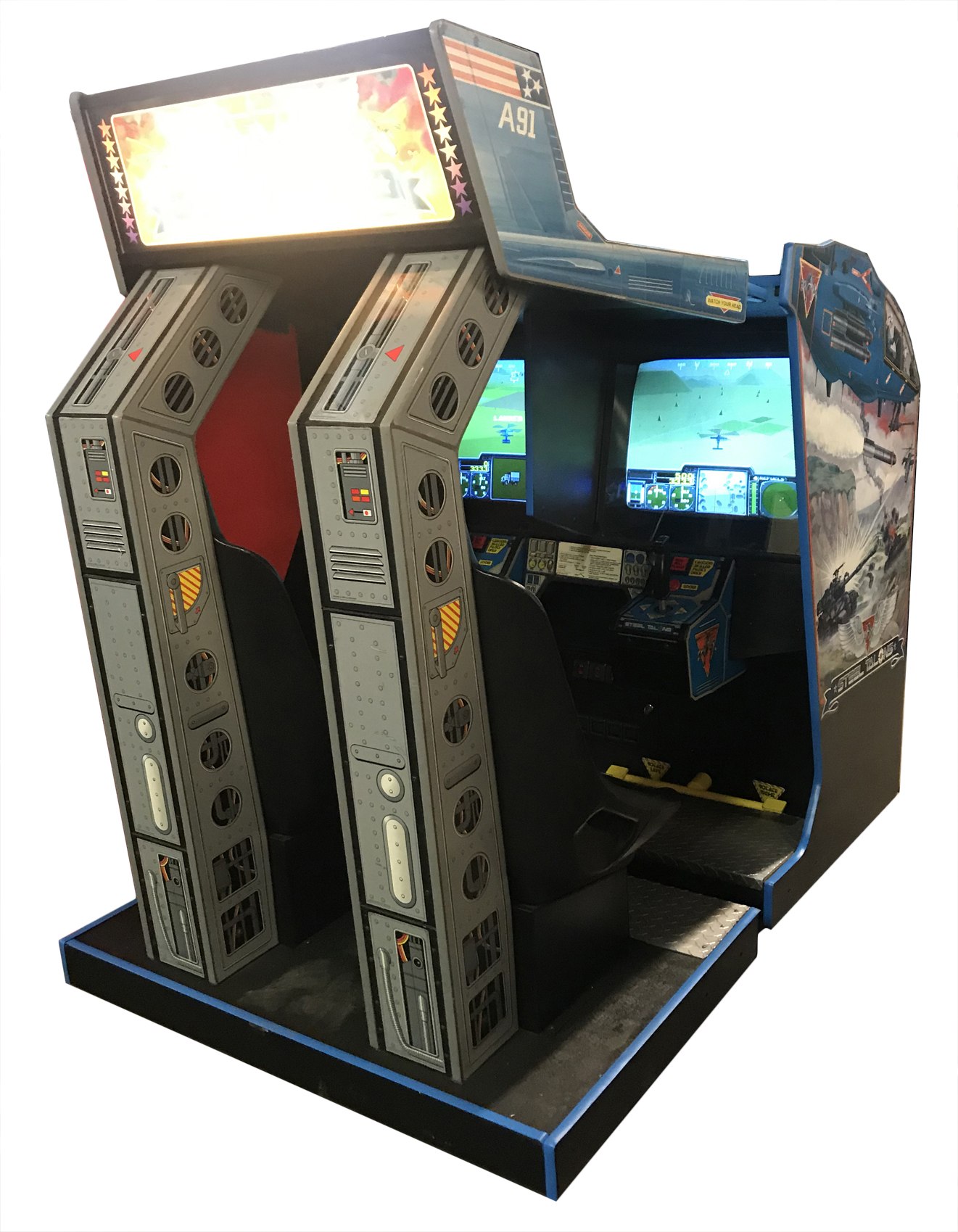
1991 – Steel Talons – a combat-helicopter simulator in 3D.
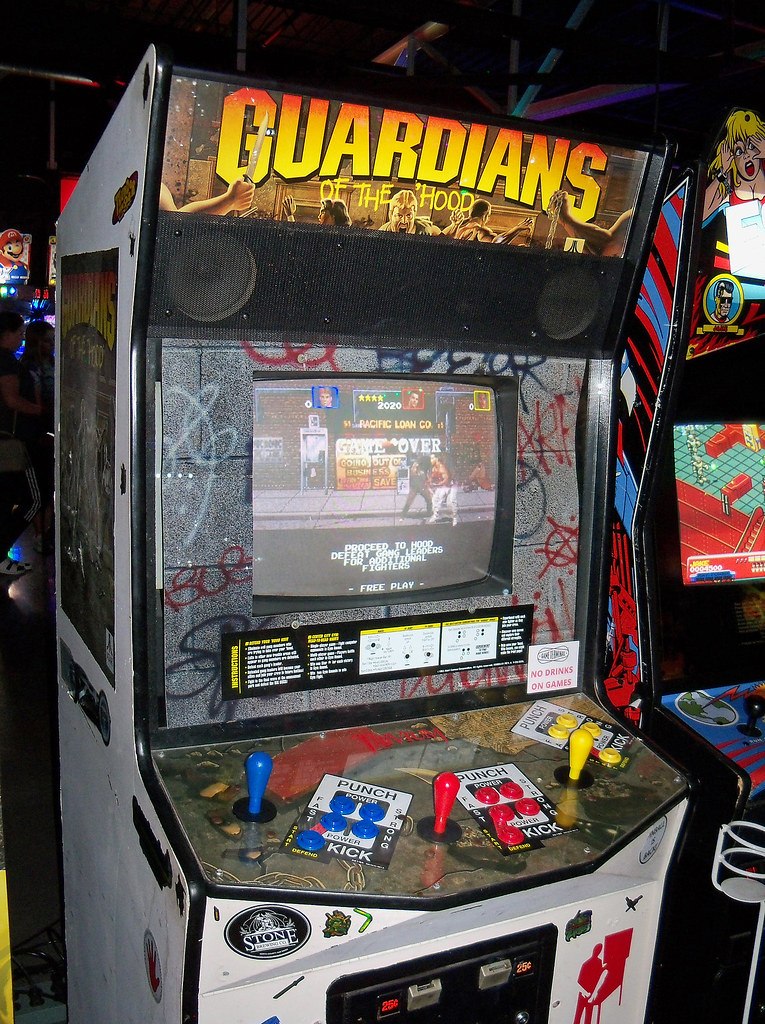
1992 – Guardians of the ‘Hood – An arcade beat ‘em up in the spirit of Final Fight
1993 – Moto Frenzy – a 3D motorbike race.

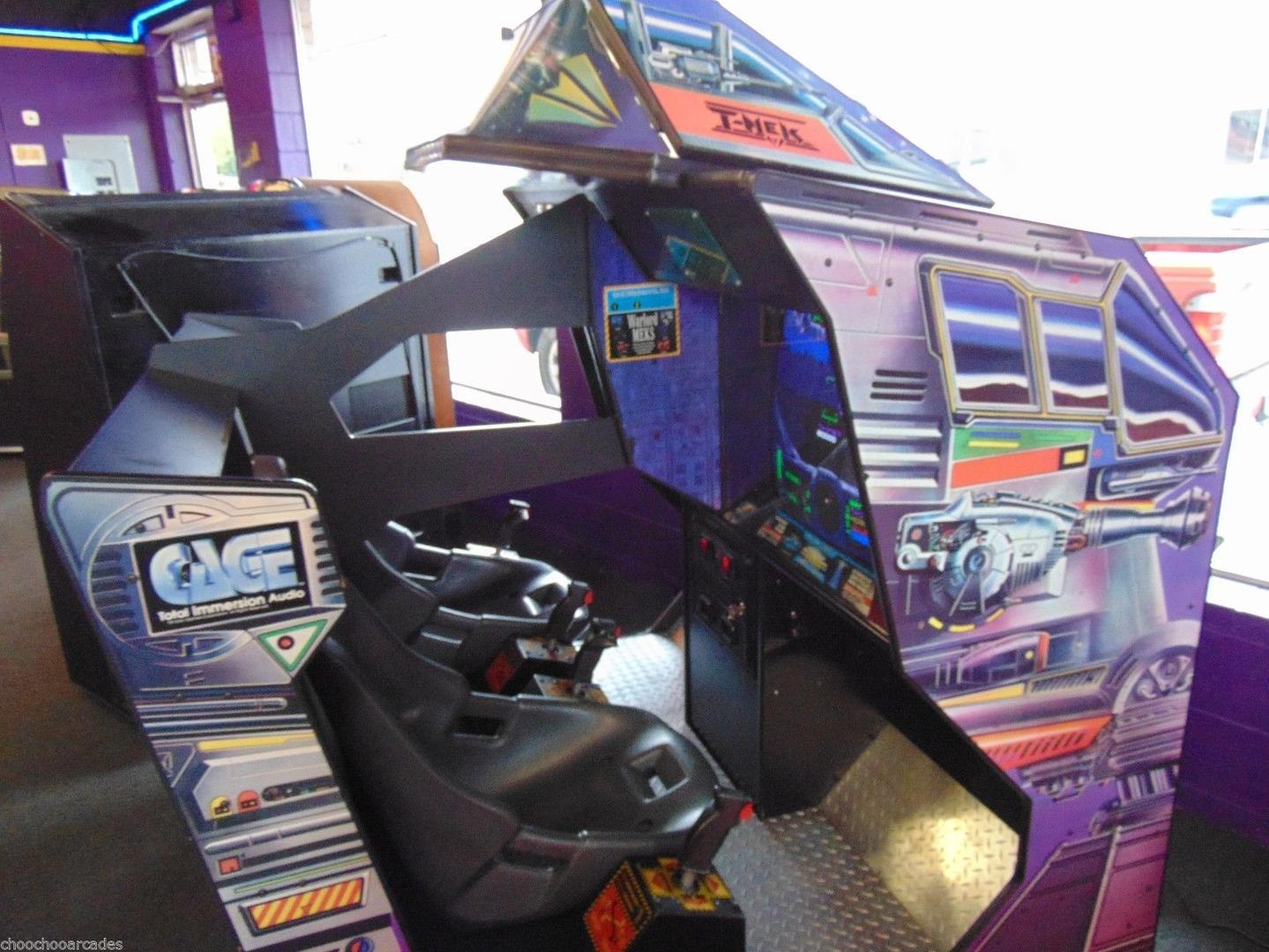
1993 – T-Mek – A 3D tank battle arena.
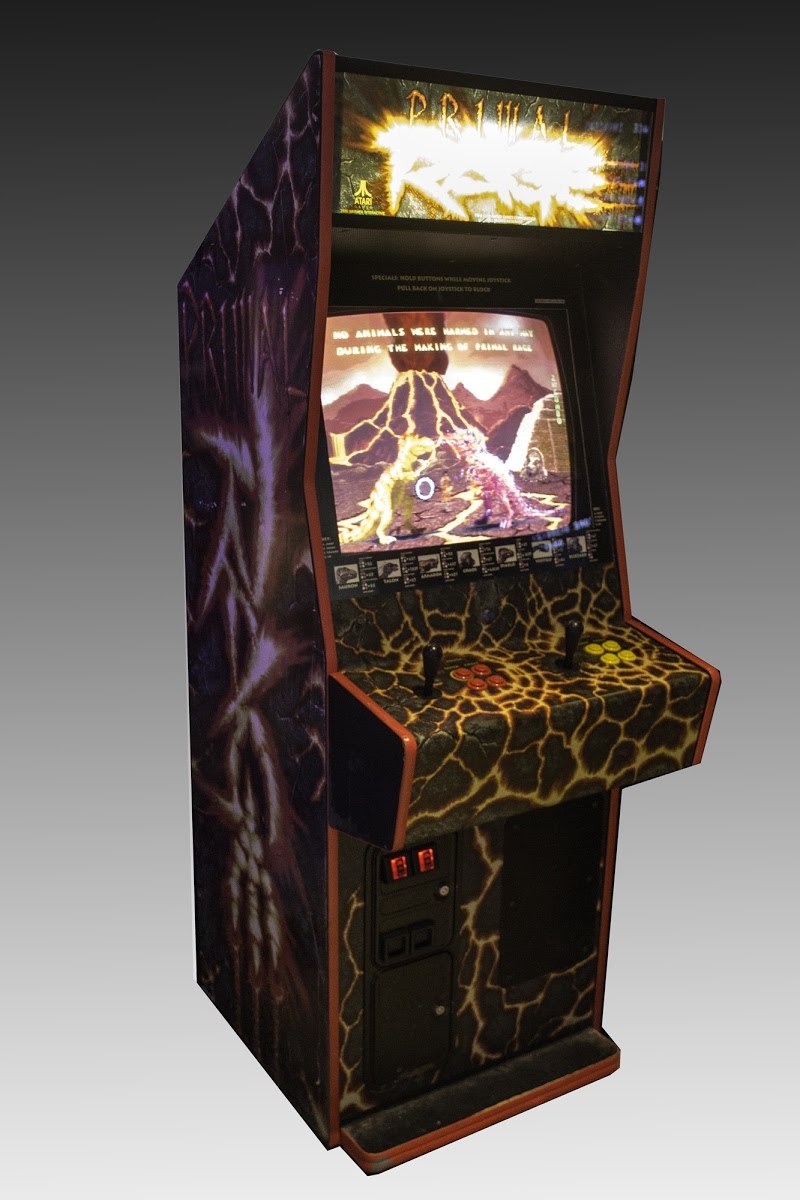
1994 – Primal Rage – A fighting game with dinosaurs and monsters that competed with Mortal Kombat.
1995 – Area 51 – One of the first arcade shooters with a light gun, done in FMV style (video inserts with real actors).
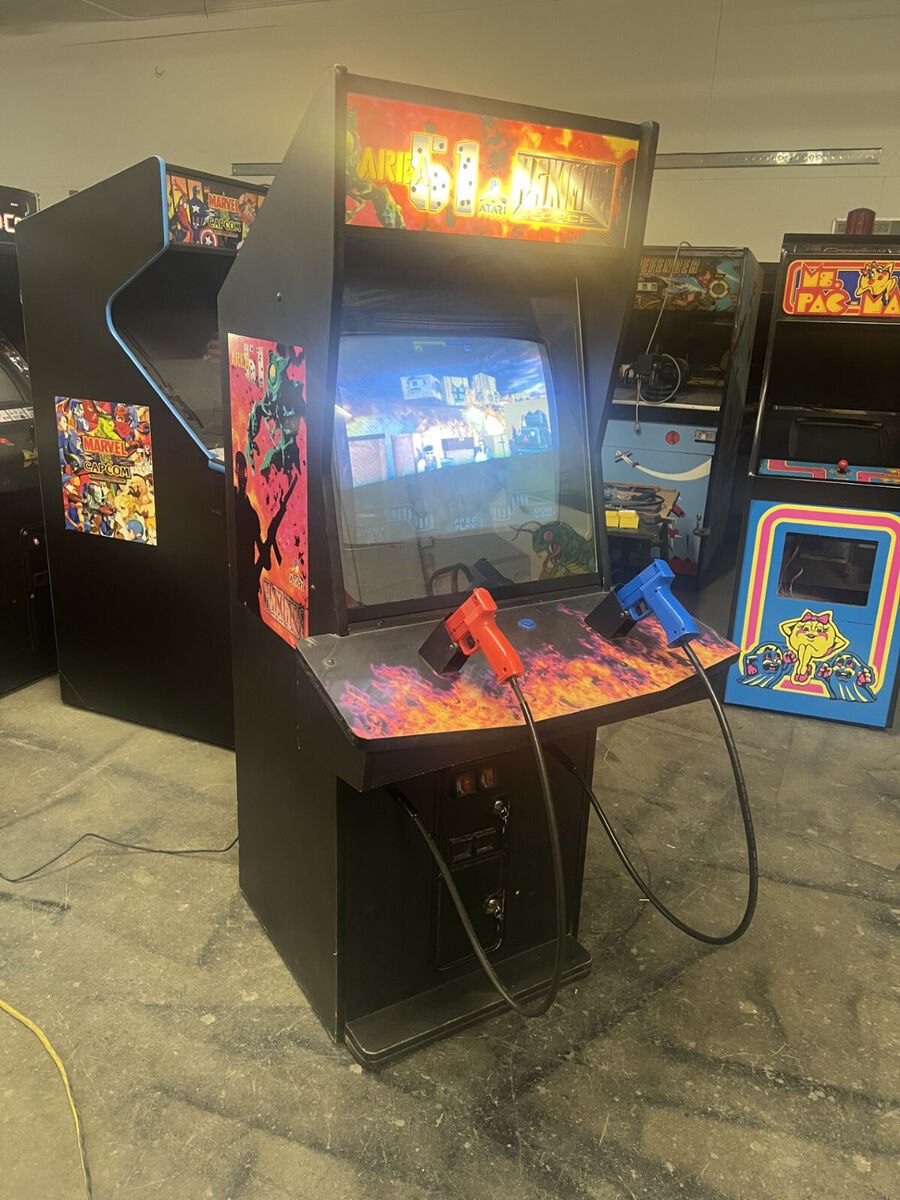
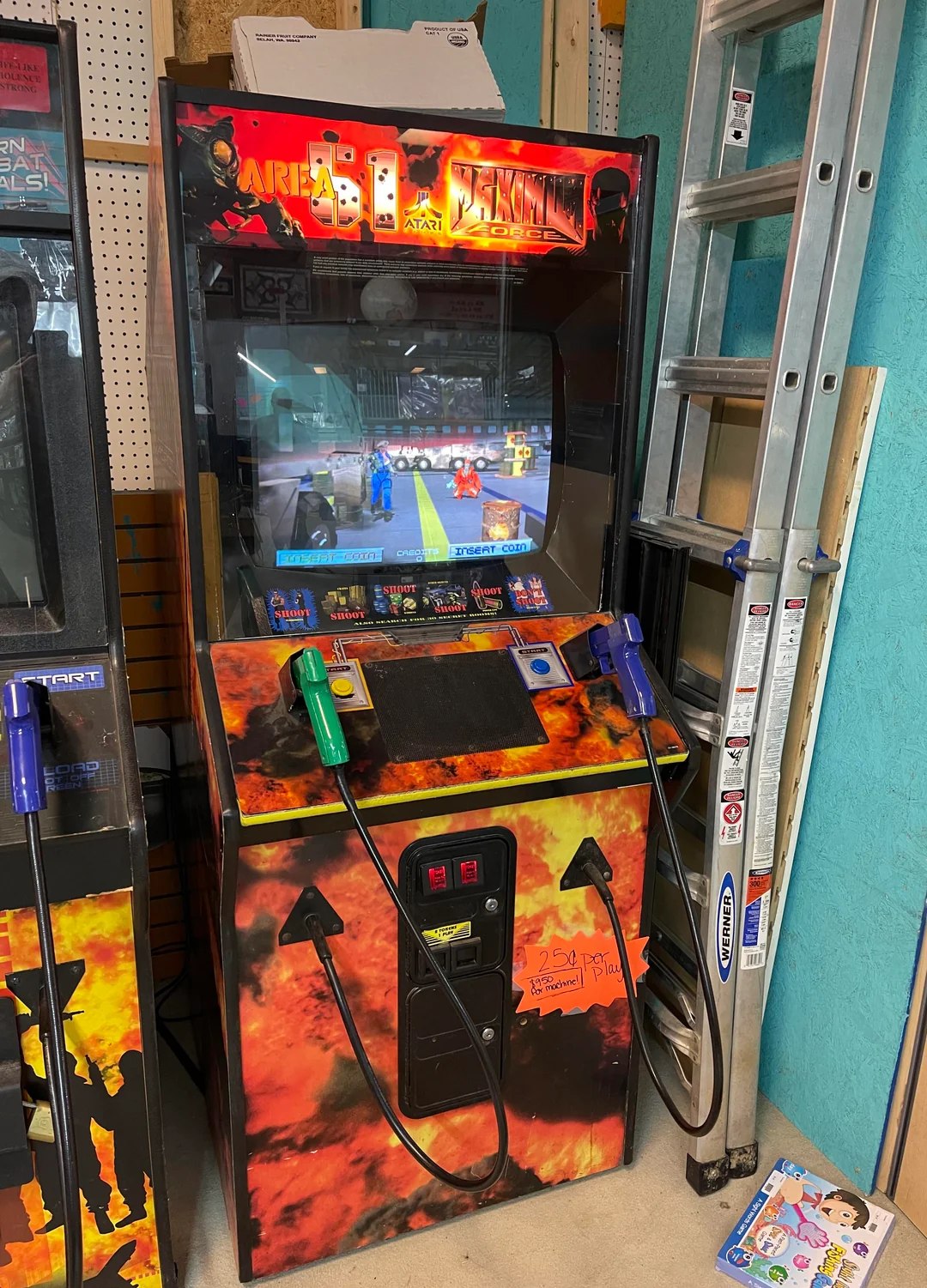
1996 – Maximum Force – A sequel to Area 51, another light-gun shooter.
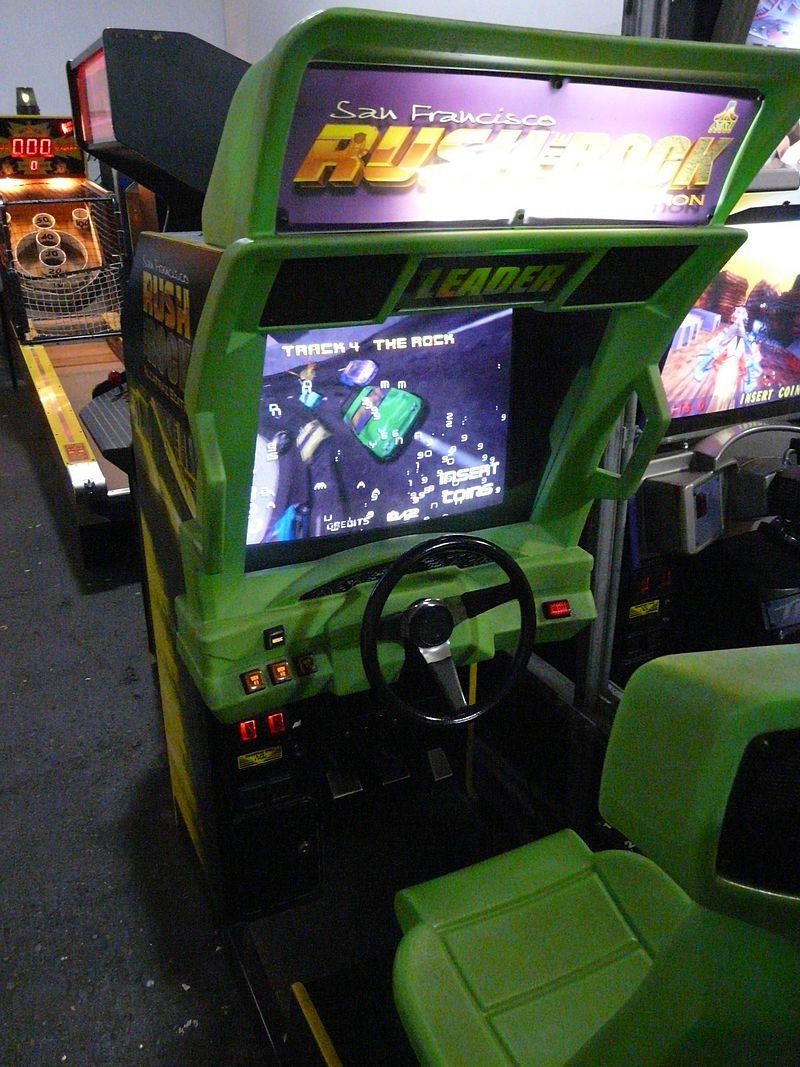
1997 – San Francisco Rush: Extreme Racing – an arcade race with open tracks and jumps.
1998 – California Speed – the same game, but in California

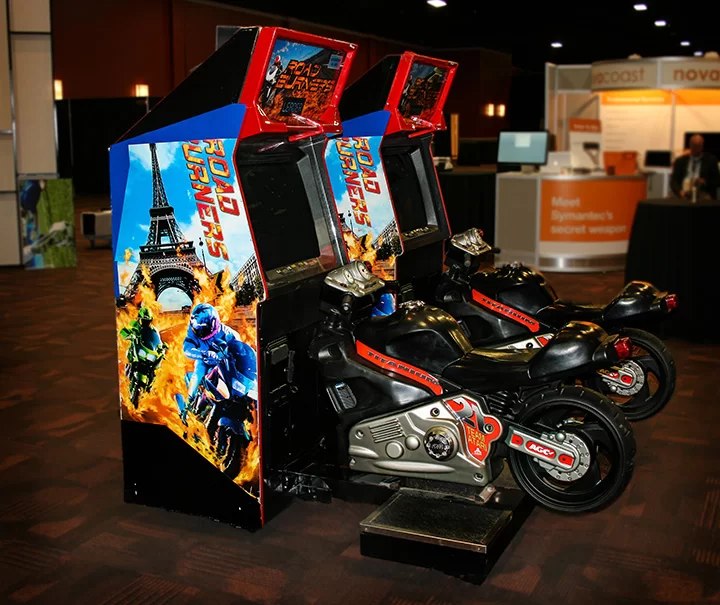
1999 – Road Burners – Atari's Road Rash.
With the growth of the home console and personal computer industry, Atari switched from arcade machines to producing consoles such as the VCS/2600, which became one of the first mass-market home gaming systems. The console gained enormous popularity and acclaim, but by the end of the 1970s Atari already faced a new challenge — a sharp rise in competition on the console market and the drift of players toward PCs.
In 1984 Atari, or rather the part of it responsible for consumer electronics, including R&D and consoles, was sold to the Tramiel Group (a group headed by Jack Tramiel, founder of Commodore), due to worsening financials and a growing debt load. Warner kept the still-profitable Atari Games with its developers and game rights. Later the first Atari would be renamed Atari Corporation but, after a few years, in 1996 it would be sold again. This time to JTS, a maker of disk drives, but soon that one found itself deep in the red and dragged JTS down with it. To avoid going under, JTS put Atari through bankruptcy in 1999 and closed it, keeping the developments, patents and copyrights for itself. These shortly went to Hasbro, and Atari Interactive appeared.
Hasbro tried to revive the brand, but in 2000 it itself was bought. Infogrames, a French game development and distribution company, completed its merger with Hasbro and in 2008 fully finished the acquisition of Atari, returning it to the market as an independent brand under the name Atari SA, out of which Atari Token, Atari Casino and Atari LLC later spun off — the first one's purpose is clear, the second deals in the ungodly business of gambling, the third sells licenses for old games. For weight, Nolan Bushnell was invited back into the company, offering him a golden seat on the board. In April 2010 he returns and becomes an observer of the board of directors, hoping to return Atari to the pedestal it had once built itself, and to help the brand adapt to the new realities of the game industry.
In the early twenties Atari buys back Atari Token, which had managed to mine some bitcoins somewhere, buy back part of itself from the parent company and start making some games, and merges it with Atari LLC, which are now called Atari Blockchain but have nothing to do with bitcoins and keep profiting off oldies — i.e., they trade licenses for old games. They take away the gaming division, buy up a few studios along the way, and become Atari Gaming. Some kind of soap opera, honestly.

And where did Ethan end up in the end? Well, Ethan — that is, Nolan — in '22 vacates the golden seat, gets a parachute of the same color, and now tours the U.S. universities telling the success-story of the whole Atari brood named after himself.
Asteroids
Although Space Invaders (1978) was the first arcade game that began recording high scores, Asteroids (1979) took the next step, giving players the ability to record their initials in the high-score table. The game, developed by Ed Logg, used monochrome vector graphics, which made it possible to display fast-moving objects, such as asteroids and spaceships, with crisp, detailed lines that didn't exist in other games of the time that used pixel graphics. This made Asteroids unique, giving the game a feeling of being high-tech and dynamic. Interestingly, the vector graphics used in Asteroids later evolved into polygons, which became the basis for 3D graphics in games.
I never played the original versions of Asteroids — however original they could be in the late nineties — but something similar was on one of the discs bought at a computer flea market. Later I saw and played it on an actual machine at one of the game expos. Well, what can I say — on the machine it plays many times more interestingly and excitingly, and I understand why people chose to play on arcades instead of home consoles.
Galaxian
Other pioneers in the arcade industry were Bally/Midway, who showed Space Invaders in 1978. There were several elements there that appeared in various other games, but not all together at once. First, it had color graphics — not just lines, dots and circles, but graphics drawn by an artist and transferred to the technical capabilities of the time. There was already gameplay, meaningful and showing some kind of story, a high-score system that let players compete for leadership. A choice of game modes and animations. No wonder the game climbed to the top of the charts within a couple of months and didn't leave for a very long time. Thanks to the enormous success of Space Invaders, its clones, followers and sequels, arcade halls had a 2-to-1 ratio of this game to others, and the game itself became an icon of its era.
Released in 1979, the game was a continuation of the technological changes in the industry, significantly expanded the possibilities of arcade scrolling shooters and became the basis for a whole series of sequels. See, sub-genres are already starting to appear here.
Galaga, released in 1981, was the most well-known sequel, continuing the concept of Galaxian and adding several new mechanics. Players could now rescue their ships, and if their ship was shot down, it could return to the game and become even more powerful. Unfortunately I only got to play the game itself on a console, and I never saw a live arcade of it IRL — I don't know why, but expos might bring a Galaxian, while the sequels get forgotten.
Later games, such as Galplus, Galaga '88 and Galaxian 3, improved the graphics and added new difficulty levels and varied elements. Each of these games continued the traditions of Galaxian but also introduced its own unique changes. You could say that Galaga became the first sequel, or even the first game series, in the industry.
Pac-Man
In 1980 Namco released Pac-Man, a game that became a real breakthrough in the arcade industry, attracting a far wider audience than the traditional games of the time. One of the reasons for such success was that Pac-Man abandoned the standard "shooting" theme and focused on exploring mazes, which significantly broadened the circle of players. The game was created with a female audience in mind, something that was almost unheard of in arcade games of the time.
A tall tale about Pac-Man, I won't vouch for its truth
A summer day in Japan, when developer Toru Iwatani is thoughtfully having lunch in a little pizzeria. On the table in front of him lies a pizza with one slice missing. This strange and almost comical sight of a round pizza becomes the missing element for the game being developed.
In that moment the idea was born: to create a simple but charismatic character for arcade machines that would look as if someone had just bitten a piece out of it. So the original design arose, resembling a smiling face ready to "eat" everything around it.
Pac-Man's controller was simple: a multi-button joystick that let you move the character in four directions. Unlike many other games where the main goal was to destroy enemies, in Pac-Man the character, by gobbling up pills, gained for a time the ability to devour the ghosts. The game also had big colored energy pills that gave you a chance to briefly "turn the tables" on your pursuers.
Development of the game began in 1979, and 18 months of work by Toru Iwatani and his team bore fruit. The developers wanted to create a game that would be intuitive for everyone and wouldn't include violence — yeah, yeah, muttered Pac-Man through his teeth, finishing off the last ghost. But most people remember Pac-Man not so much for its gameplay as for its cult music.
The game became a real phenomenon and at the peak of its popularity surpassed every possible record. In 1981 more than 300,000 machines were sold around the world, and Pac-Man became the most popular arcade game of all time. In 1982 a sequel was released, Ms. Pac-Man, where the main character became a "woman" — if that being without secondary sexual characteristics can be called one, apart from the bow.
This was an important cultural event, since the game gave players a character with whom many girls could identify. In Ms. Pac-Man the developers added new mazes, improvements to the game mechanics and varied elements. The sequel brought even more success, but in sales it didn't even reach the first 100k. But Pac-Man in any case became an important milestone in the history of arcade games and a symbol of the gaming '80s.
Donkey Kong
In 1977 Shigeru Miyamoto was hired as an artist at Nintendo. The company initially assigned him to work on a game called Radarscope — an underwater game that amounted to simple button-pressing without any real story or characters. Although this was a typical style of games at the time, Miyamoto wanted to create something unique.
The result of Miyamoto's pushing his own ideas was a game that was something between King Kong and Beauty and the Beast. An ape kidnaps the girl of its keeper and runs off. The player takes on the role of the keeper (Mario), who becomes the hero of this story, trying to rescue his girl (Pauline) from the clutches of the beast.
Donkey Kong's simple plot brought Nintendo to the top of the American game market charts. The game became one of the first to use complex behavioral mechanics with multiple levels and unique characters. It wasn't just a platformer but a whole story, with a written plot that developed as you progressed through the levels.
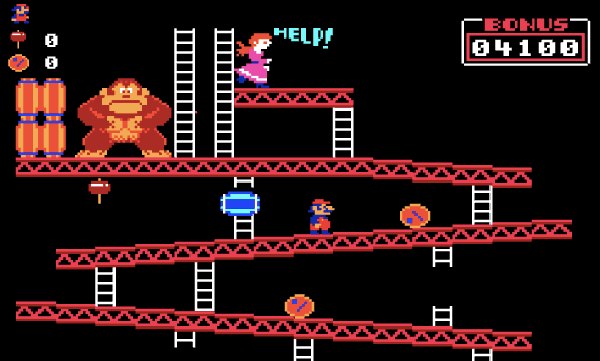
Mario, who at the time was merely Jumpman, was the company's first significant game character, and it was his appearance that became the starting point for creating a whole Nintendo universe. As you probably all know, Mario was inspired by the image of an Italian plumber; in some interviews Miyamoto later admitted that Mario was also created after consultations with child psychologists, so as to be easily recognizable and accessible first and foremost for children, thanks to his bright look with a red cap and a blue mustache — the most contrasting combination for kids and teenagers.
A tall tale about Donkey Kong, not true of course
The name Donkey Kong is connected to Miyamoto's original intention to call the game "Stubborn Gorilla," because the gorilla in the game was supposed to personify stubbornness. However, while working on the English version of the game, the sales department said the name "Stubborn Gorilla" wouldn't be catchy or commercially attractive enough for the American market.
So they started looking for a more suitable English translation that would fit a Western audience. That's how the word "donkey" came about, to convey the idea of stubbornness, since donkeys are often associated with stubborn animals. The second part of the name, "Kong," was inspired by the famous movie character King Kong as something more familiar to Americans, symbolizing a gorilla.
Although the name might seem strange or ridiculous at first glance, it turned out to be a success not only for the Western market but also caught on back home.
After the success of Donkey Kong, Miyamoto and his team created several sequels and reinterpretations of the story, including Donkey Kong Junior, where players were invited to switch to the role of the opposite hero. The evil Mario brothers steal Kong's papa, and the son has to stand up for his father. This was one of the first attempts to create a non-standard sequel where the usual roles were swapped, which also influenced the development of the game industry and approaches to building franchises. The game didn't enjoy much success, true, but it did give those very Mario brothers the chance to appear as separate characters.
In 1983 the game Mario Bros comes out, where Mario and his brother Luigi became full-fledged characters playing a central role in an adventure story. The plumbers fought an endless stream of enemies in the form of various creatures. The game is considered a possible forerunner of multiplayer platform games, where two players were given the chance to play simultaneously, which was a real novelty at the time.
With the arrival of the NES console in 1985, Super Mario Bros became the flagship project. For several years the game set the standards for new platformers, defining not only the mechanics but also the visual style. In part thanks to new technologies, Super Mario Bros. offered solutions such as an animation buffer, which made them smoother, dynamic level loading, and a huge number of secrets. Secrets had existed in games before, but here Auntie Sonya — that is, Nina (Nintendo) — made them one of the central elements of the game itself.
Later, Miyamoto didn't stop at just the Mario series. With each new console system he kept releasing games that became an important part of the platform's ecosystem. All the projects, including franchises like The Legend of Zelda, Star Fox, Pikmin, and Metroid Prime, were a continuation of his ideas, developing new game worlds and expanding the capabilities of the games themselves, including the use of 3D graphics, more complex storylines and characters with whom players could identify. But it's also thanks to this man that we can enjoy Nintendo's games only on its own consoles.
Not only Mario's papa, but also the keeper of the old ways
Miyamoto, as one of Nintendo's leading developers, had a significant influence on the closedness of the company's ecosystem and on its approach to emulators and ports of games. From the very beginning Nintendo held to a philosophy of creating exclusive content for its platforms. Under Miyamoto's leadership Nintendo created games that were so tightly bound to the hardware that porting them to other platforms became extremely difficult, if possible at all.
One of the reasons Nintendo resists the creation of emulators and ports of its games so strongly is the desire to ensure maximum control over the quality of content — and a couple of shekels, where would we be without that. Unlike competitors such as Sega, Sony or Microsoft, who at certain points began porting games to other platforms, Nintendo's philosophy is to maintain the uniqueness of content. Nintendo's closedness meant not only developing exclusive games but also fighting those who tried to emulate them. Nintendo has waged and continues to wage an active battle against developers of emulators, ROM images and even against fan projects that try to adapt its games for other systems.
The company always ended up getting emulators removed that let games run on personal computers, such as ZSNES or SNES9x, and also actively pursued sites and people who distributed copies of games. Miyamoto and his colleagues supported this approach despite criticism from the fan community and other developers. Even in the era of digital stores and cloud services, Nintendo remains one of the most closed companies in the industry, which often sparks discussions about its policy regarding content availability and emulators.
The birth of console games
Although the Magnavox Odyssey — the first home game console — was released back in 1972, it couldn't make a significant impact on the mass market. First, the Odyssey simply came out at the wrong time. It was a fairly primitive console with a limited set of games, and it could only be connected to a TV. On top of that it was quite expensive, and the middle class couldn't always afford it, while those who could weren't interested in such a purchase. Despite this, it became a milestone for the industry, demonstrating that video games could go beyond arcade halls and become part of home leisure.
The real video game boom that began in the late 1970s, when arcade games became widely popular and relatively quickly paid back their costs, which made it possible to buy new machines and pay them off even faster. But this market wasn't bottomless — a couple of clubs were enough for a neighborhood. And then consoles began to transform into more accessible systems, and the shift to a business model oriented toward consumers (business-to-consumer) rather than clubs (business-to-business) gave manufacturers new opportunities. Home consoles began to develop actively when manufacturers realized there was great potential in selling gaming devices directly to people; even if the price of the console wasn't very high or profitable, volume could be used to lower both the cost of the console itself and to earn a good profit.
By selling an arcade machine with a cost of 150–300 bucks, you could make 500–700 in profit, but such a machine served, say, up to 100 people. By selling directly to those same people you could earn 100 * $100 = 10k, and even if the cost of the console were 80%, the profit would already be $2k instead of a hypothetical seven hundred. But in large-scale mass production the cost of the hardware rarely rose above 25%; the rest went into marketing and related expenses. As of 2021, the estimated cost of the PS5 was about $500 with in-house production in Japan and roughly half that with full-cycle contract manufacturing in China. With large assembly volumes the cost could be lowered by another 20 percent or so, thanks to the effect of bulk orders.
Unlike arcade machines, which were available only to professional operators, home consoles that could be connected to a TV opened up access to games for everyone who could afford to buy such a console. The popularity of game consoles began to grow because they were relatively inexpensive and offered the chance to play at home. The market began to fill up with devices like the Atari 2600 (released in 1977), and gradually other major players began to appear, which ultimately led us to the big three — Sony, Microsoft and Nintendo — who would later play a decisive role in the industry. But those are still 20 years off on foot, and for now the transition from expensive arcade machines to affordable home consoles was the moment that laid the foundations of the industry we have today.
Atari 2600
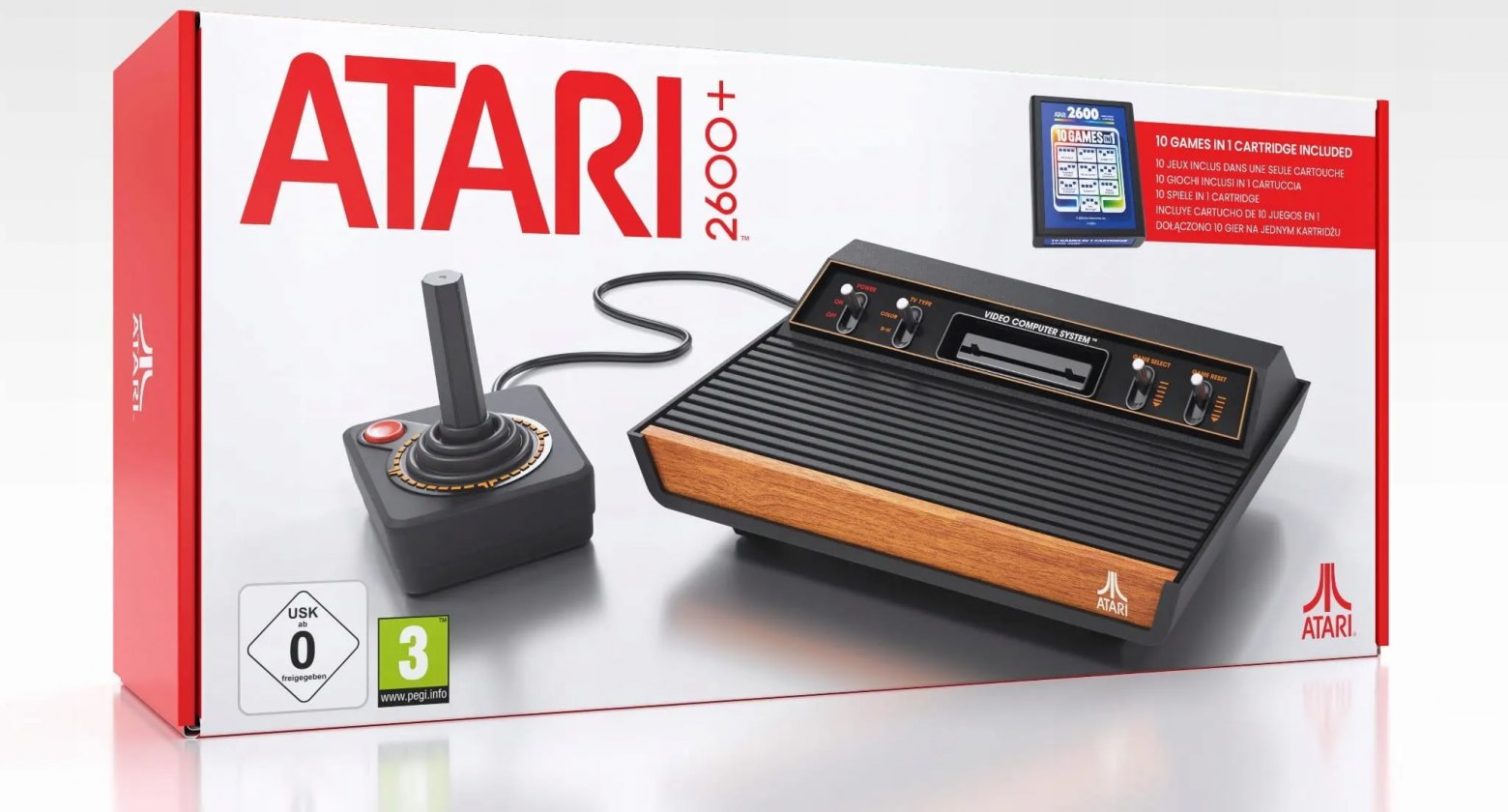
When the Atari VCS (later known as the Atari 2600) was released in 1977, it offered cartridge technology, which made it possible to change games without changing the platform itself and essentially opened up huge possibilities for varied content. This not only made the console accessible to a wider audience but also marked the start of the entire subsequent history of this device format. The Atari VCS was significantly cheaper than the market — both arcade machines and the more expensive computers. Games ranged from simple text quests to more complex adventure games with visual effects, which attracted a varied audience of players. Adventure, one of the first adventure games for the console, included elements of item-finding, exploration and puzzle-solving, and gave birth to a new quest genre. When Atari adapted Space Invaders for a home console in 1980, it was the first arcade game ported to a home platform, which proved that consoles could be not only an alternative to arcade machines but a full-fledged competitor to them at a much lower cost.
Atari continued releasing new models, the 5200 and 7800, but they couldn't repeat the success of the original 2600. The 5200 and 7800 models faced problems both technical and ergonomic, like awkward controllers. And the shortage of games limited their appeal, so the Atari 2600 remained the company's most successful console and one of the most significant products in the history of video games.
Atari and the rest
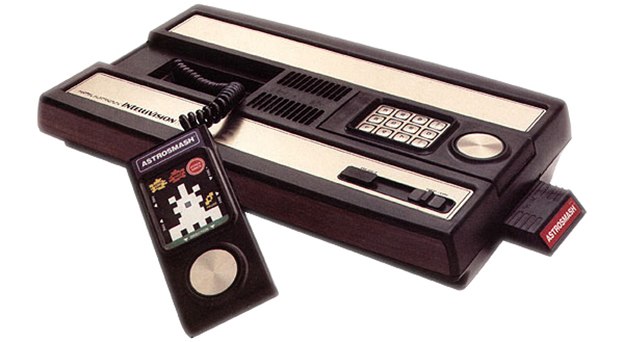
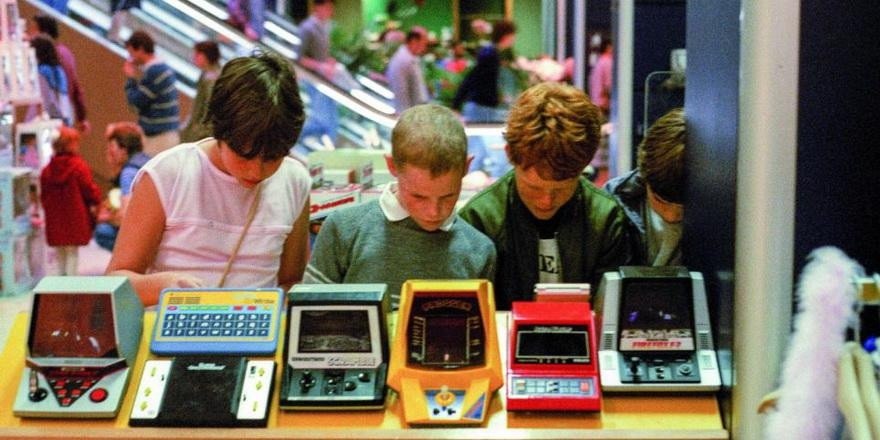
Competitors, seeing how Atari was skimming the cream off the market, also wanted to bite off their slice of the pie, and two years after the release of the VCS the company Mattel introduced its console Intellivision. This gaming device, although more expensive, surpassed Atari in many technical characteristics, offering more powerful hardware, better graphics and sound. Unlike the VCS, which used a standard joystick, Intellivision was equipped with a controller with a numeric keypad and a control disc, resembling modern laptop trackpads. This approach made it possible to implement more complex game mechanics, and for ease of control each game came with special plastic overlays that were placed over the controller's keypad, helping players navigate the buttons.
Atari, with its revolutionary VCS that paved the way for home consoles into buyers' hearts, clashed not only with Mattel and its more technological Intellivision. The battle unfolded both on store shelves and in office corridors: the companies actively poached developers from each other, using generous offers, secret negotiations and even unscrupulous methods.
In the game industry of the time there were no strict contracts limiting the movement of employees between companies. This allowed Atari and Mattel to stage real talent raids. Several Atari engineers who worked on technologies for the VCS left or started their own companies. According to former employees, Mattel offered not only higher salaries but also a certain creative freedom, unlike Atari's rigid corporate structure. In response Atari took countermeasures, up to and including threats of litigation for disclosing trade secrets.
Mattel, for its part, used unofficial methods to attract Atari employees. One such example was offering contracts through shell companies to avoid direct legal conflicts. As competition between Atari and Mattel grew, the first serious lawsuits began to appear. In 1982 Mattel sued several former employees, accusing them of passing trade secrets to Atari. The case didn't go to trial but set a precedent, forcing companies to approach personnel reshuffles more carefully.
Atari didn't stay on the sidelines either. In one internal letter that leaked to the press, the company's management demanded a "stop to the talent drain" and the development of measures to retain employees, including bonus programs and stock options. Many of these moves happened under strict secrecy. Atari developers were invited to "informal" meetings in cafes or restaurants, where they were offered significantly higher salaries and promised freedom in game development.
As a result of the personnel moves, many Atari and Mattel projects got unexpected improvements. For example, the Intellivoice technology, which allowed voice synthesis, was perfected by former Atari engineers, and some ideas laid into the VCS platform were reworked and used in later Intellivision models.
Nevertheless, both giants ultimately lost the main battle for the buyer. By the mid-'80s the game industry went through a serious crisis caused by a glut of low-quality games and a drop in consumer trust. Atari fell apart, and Mattel closed its gaming division in 1984. Despite this, the "spy war" between Atari and Mattel left a significant mark on the history of video games. It was during this period that the principles of competitive struggle in the game industry were laid down, along with the first draconian restrictions that are still applied to this day — from exclusive contracts to legal bans on developing similar themes at a new company. Ehh... so many years have passed, and essentially nothing has changed.

The spy war between Atari and Mattel
In the late 1970s — early 1980s Atari and Mattel found themselves at the epicenter of fierce competition for leadership on the home console market. Their confrontation, often called the "war over the gamepad," included not only marketing battles but also rumors of industrial espionage, litigation and a struggle for technological superiority.
Atari 2600 dominated the market, but by 1979 Mattel had released Intellivision, positioning it as a more advanced system with improved graphics and sound.
Intellivision used a 16-bit processor (versus Atari's 8-bit), which made it possible to create more complex games. This became a key argument in the advertising war.
Mattel launched a series of commercials with actor George Plimpton that directly compared Intellivision with the Atari 2600, emphasizing its superiority. For example, in an ad for a baseball game Intellivision boasted realistic graphics, while Atari was portrayed as primitive.
Atari responded with aggressive marketing, focusing attention on its extensive game library and accessibility.
Both companies used a number of common contractors to design individual elements of the consoles, which could have been used for industrial espionage, but there are no confirmed facts.
Atari was working on improved chips to catch up with competitors; in court certain technical solutions were presented that repeated not only Mattel's developments but also Coleco's — the memory management scheme was similar to its solutions.
There were rumors that engineers moved from one company to another, bringing secrets with them. Former Atari employees who joined Mattel could share knowledge about console architecture.
Some sources mention cases of stolen game prototypes or documentation, but there's little confirmed evidence — most of the stories remain part of industry folklore.
Atari filed suits against Mattel for patent infringement, and Mattel, in turn, accused Atari of copying game mechanics. For example, the dispute over the game Kool-Aid Man (Mattel) and its similarity to Atari projects.
Conflicts also arose over licensing. Atari had exclusive rights to port arcade hits (Pac-Man), but the quality of their implementation on the Atari 2600 was often criticized, which Mattel used in its advertising.
Nolan Bushnell (founder of Atari) left the company in 1978 for personal reasons but never advertised which ones; the severance was over 15 million
Matteo Otranto (Mattel) headed the electronics division and counted several FBI bigwigs among his friends. He's credited with rumors of wiretapping in competitors' offices and the story of planting a "mole" in Atari who passed on information about internal developments.
Atari, by rumor, tried to get access to several Mattel console prototypes, using connections among the organizations that audited and prepared Mattel's advertising campaigns.
The rivalry accelerated technological development but also showed the risks of an uncontrolled race for novelties. The experience of these companies influenced the next generation of consoles, including the Nintendo NES.
Developer salaries grew significantly, as companies tried to retain talented specialists.
Attention to copyright and trade secrets increased, which subsequently led to the adoption of stricter intellectual property protection laws in the game industry.
Companies began to close off their ecosystems more actively to prevent technology leaks — this trend continues today.
The market crash
There are several theories explaining the downturn in the video game industry in the early 1980s. Perhaps it was just a temporary crisis caused by the absence of truly revolutionary platforms and games; another reason was market oversaturation: more than a hundred companies released game cartridges with ports of the same games, which led to a glut of product and a drop in quality. Publishers tried to quickly cash in on the popularity of video games by releasing cheap, poorly thought-out games that undermined the already-weak trust of the buyer.
One of the most famous examples was the infamous "E.T. the Extra-Terrestrial" by Atari, developed in a rush in just a few weeks — I've heard four weeks, anyone less? The game turned out so bad that millions of unsold cartridges were buried in the New Mexico desert.

Because of the oversaturated market, game prices dropped to $5, which made developing new projects unprofitable even for big developers. At the same time home computers, offering more capabilities, began to gain popularity; developers, fearing a complete collapse of the console industry, began moving into the computer game sector. Newspapers ran articles with the questions: aren't video games just a fleeting fad rather than a new form of art?
Auntie Nina saves game development
But Japan — the homeland of real samurai and game-dev legends — in the person of Nintendo leads developers into a brave new world with its console Famicom, later known as the NES. After the video game crash of '83, many companies abandoned the market — overall every second game studio closed, along with consumer trust. However, Nintendo offered not just another console, they offered a new economic model for promoting games, and a whole ecosystem with strict quality control. Of course, it was Nintendo's ecosystem.

One of the company's key decisions was the introduction of game licensing through the Nintendo Seal of Quality system, which any self-respecting platform holder now uses. This meant that all games went through strict "manual" selection before release, excluding low-quality projects and ports like those that had flooded the market in the early '80s. Nintendo also introduced strict restrictions on third-party developers. You could sell no more than five games a year on this platform; with the big players there were separate deals, but this sharply reduced the number of trashy games.
Nintendo Seal of Quality
Developers couldn't just release a game on the NES and on competing platforms.
Goal: improving game quality
Reality: many companies were forced to work only with Nintendo, even if they wanted to release games on other platforms. Which led to studios closing. For example, Capcom couldn't release Mega Man on Sega. Square and Enix (before the merger) released Final Fantasy and Dragon Quest exclusively for the NES.
All cartridges were produced at Nintendo's factories, and the company took its cut from every copy.
Goal: high build quality and minimal defects
Reality: monopolization of the cartridge production and sales market, sold to studios at an inflated price. This not only brought Nintendo huge profits but also gave it leverage: if a studio violated the terms, its cartridge production could be delayed or limited. Tales about an eight-day work week before a release.
Strict manual quality control — each game had a dedicated employee in the QA department, paid for by the studio, who tested the game from beginning to end.
Goal: to prevent low-quality projects from shipping.
Reality: a decline in game quality and censorship. The ban on blood in Mortal Kombat on the SNES. The removal of religious symbols (crosses) in Castlevania. They removed scenes of violence and revealing costumes (Final Fight).
An exclusive network of stores for selling games and strict licensing terms.
Goal: to prevent the market from being overrun with low-quality games.
Reality: a ban on retailers selling competing consoles or giving preference to NES games over everyone else's. Stores that broke these rules didn't get new shipments.
No more than five games a year
Goal: to prevent the market from being overrun with low-quality games.
Reality: studios simply created subsidiaries to get around the limit. Konami created Ultra Games to release more games.
The old sales model remains in Japan to this day; the company was only clipped in the States and Europe — the licensing terms for small studios are effectively no more than five games a year. For the big ones, as they negotiate. There's still a dedicated employee for each game, but now the studio doesn't pay for testing — yet the next round of tests can't be sooner than two weeks from build submission, i.e., you can't put out more than two patches a month. You can't release more than one game to the store at a time; ports of old games go through a separate Nintendo division with which you have to sign separate work contracts. Well, the whiteness and fluffiness haven't gone anywhere since the early eighties.
And then of course there were its own games, which didn't just show off more complex graphics — many of them created new genres and game mechanics. Super Mario Bros. as the standard for platformers — big levels, secrets, story told through narrative delivery. The Legend of Zelda — the concept of an open world and the ability to save, while Punch-Out opened up a whole new genre of simulators.
... and buries the arcade machine industry
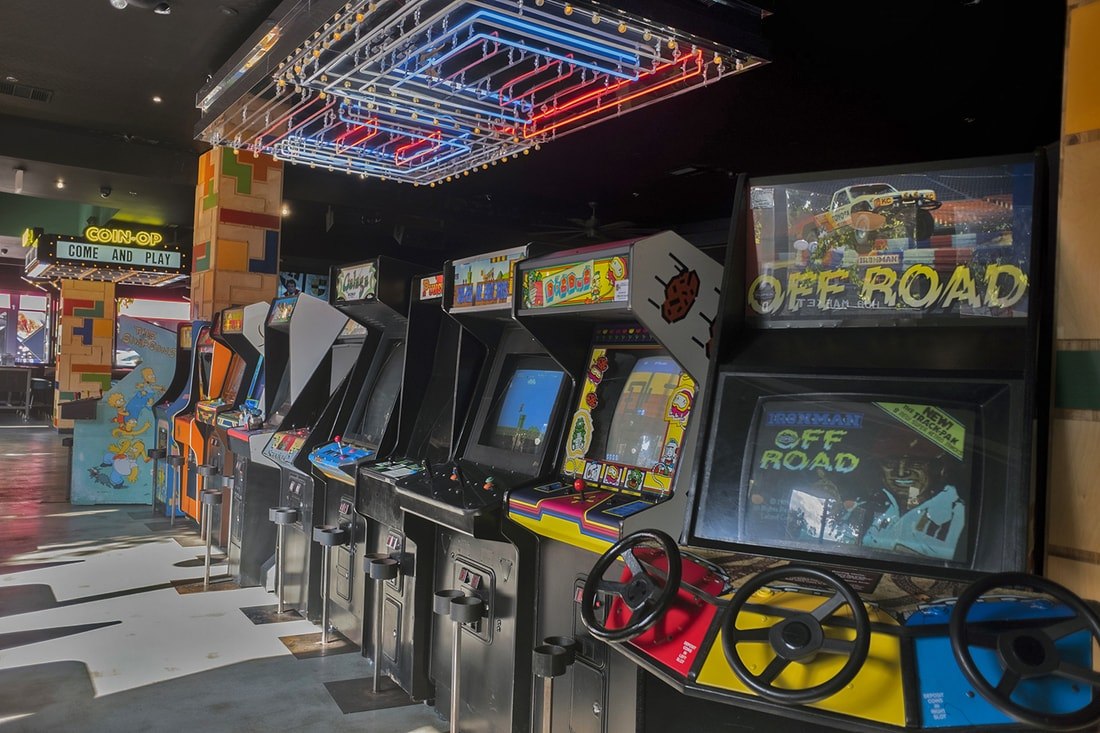
Cheap consoles and quality games led to a sharp decline in interest in arcade machines. Where before arcade machines were the only place you could play the latest titles with cutting-edge graphics, now home consoles began to offer better quality, instant delivery of the game and the chance to play in comfortable conditions. Sales of arcade machines went into decline, and by the end of the '80s nine out of ten arcade halls had closed.
In 1991 the company cemented its leadership with the release of the SNES, offering even more powerful graphics and sound. And a little later Super Mario Bros. 3 appeared, becoming the best-selling cartridge game. Nintendo didn't just save the video game industry — burying a dozen studios and a whole arcade direction along the way — it reshaped the market to suit itself, setting strict terms for developers and suppliers. Many companies that had previously freely released games on Atari and other platforms were forced to adapt to Nintendo's rules. Competitors like Sega tried to put up a fight, releasing the Sega Genesis (Mega Drive) and aggressively advertising more "adult" games. However, despite advertising slogans like "Genesis does what Nintendon't," it was Nintendo that set the tone for the new generations of games.
In the early '90s the antitrust authorities of the U.S. and Europe began investigations against Nintendo. In 1991 the company was forced to cancel restrictions related to exclusivity and strict price control.
... and also buries unwanted studios
Atari Games (not to be confused with Atari, Inc.; destroyed by lawsuits). They created the Tengen division to release games for the NES without Nintendo's license. To do this they bypassed the NES's protection and began selling unlicensed cartridges. Nintendo filed numerous lawsuits, accusing Tengen of copyright infringement and illegal copying of the protection code.
How they were buried
1994 – Tengen stopped releasing games for the NES and effectively shut down.
Atari Games lost huge amounts of money, was sold to Midway, and then disappeared entirely.
Acclaim Entertainment (bankrupted) released major titles, including Mortal Kombat, Turok and NBA Jam. However, Nintendo's strict requirements (on exclusivity and censorship) made the collaboration difficult
How they were destroyed
Mortal Kombat on the SNES turned out to be a flop because Nintendo removed all the blood, replacing it with "sweat." Sales went down, and the Sega Genesis version sold 3 times better.
Nintendo controlled cartridge production, which is why Acclaim often didn't get the volume of product it needed and lost profit.
Because of the restrictions on releasing games, the company couldn't work freely with other platforms.
In the end Acclaim went bankrupt in 2004. Of course, Nintendo isn't solely to blame, but its policy contributed.
Data East (couldn't withstand the fight with censorship, closed) created cult games such as Double Dragon, Joe & Mac, Karate Champ.
How they were wiped off the face of the earth
Nintendo demanded the removal of violent scenes, which hurt sales. For example, the NES version of Bad Dudes looked worse than on the arcades.
The limit of 5 games a year kept a small studio from staying afloat.
Nintendo held a monopoly on cartridges, which raised production costs.
Data East held on until 2003 but eventually closed, unable to withstand the competition.
Sunsoft (game sales blocked, closed) was one of the first studios that wanted to release games on both the NES and the Sega Genesis. But Nintendo didn't allow publishers to work with competitors while under contract.
How they were consigned to oblivion
In the '90s Sunsoft wanted to move to the Sega market, but Nintendo delayed the production of their cartridges and effectively blocked their games.
The company went bust in 1995, although it partially revived later.
Hudson Soft (bankrupted and absorbed) was known for its Bomberman and Adventure Island series and many Japanese games.
How they were driven to closure
The company kept them within strict contractual bounds
When Hudson tried to enter the PlayStation market, Nintendo severely limited their access to the platform.
Hudson lost profit, was sold to Konami in 2011, and then completely dissolved.
Rare (creators of Battletoads, Donkey Kong Country, GoldenEye 007; lost its IP) didn't close but was forced to leave Nintendo, leaving the latter the IP for its games over debts.
How they were written off
Rare worked exclusively with Nintendo, but Nintendo didn't allow them to develop games for other platforms.
Nintendo refused to buy out the studio when it found itself in debt, although it could have done so.
In 2002 Rare went under Microsoft's wing, which effectively saved it from a possible crisis.
THQ (WWE, SpongeBob, Darksiders; closed and lost its IP) in the '90s depended on Nintendo's licenses to release games for the Game Boy and SNES. But Nintendo strictly limited the company's ability to expand.
How they were driven into the grave
They couldn't move to other platforms while working with Nintendo.
When THQ did start making games for the PlayStation, Nintendo broke off the collaboration.
Without Nintendo's contracts, THQ couldn't compete with EA and Activision and went bankrupt in 2013.
Ocean Software (Batman, Jurassic Park, RoboCop; bankrupted, lost its IP) made games based on Hollywood films and worked with Nintendo, but was bankrupted while trying to leave Nintendo.
How they were sent to the dustbin of history
Nintendo strictly regulated game release timelines, which kept Ocean from adapting new films in time.
Nintendo's censorship removed violent scenes, hurting sales of action-movie games.
The limit of 5 games a year hampered the business model of the studio, which was oriented toward film release dates.
The company couldn't compete with Western publishers and was absorbed by Infogrames in 1998.
Factor 5 (Star Wars: Rogue Squadron, Turrican; bankrupted, lost its IP) worked with Nintendo for many years, creating exclusive games for the GameCube. Then there was an offer to buy out the studio and move it under Nintendo's wing, but the studio declined.
How they were left out in the cold
Nintendo didn't renew the development contract
The Lair project for the PS3 flopped; in 2009 Factor 5 nearly closed and was ready to go under Nintendo, but this time Nintendo itself declined. The studio closes, and some of the employees move to the company's internal studios. The IP is put up for auction and most of it goes to — care to guess whom?

Sega
After Nintendo's successful launch of the NES, Sega brought a whole range of interesting consoles to market, including the Sega Master System, Genesis, Saturn and Dreamcast. The SMS couldn't seriously compete with the NES, but it left warm memories in the hearts of fans. Although technically it surpassed the NES in specs (better graphics, a more powerful sound processor), the Master System couldn't, in the long run, seriously compete with Nintendo, mainly due to a shortage of games. Nintendo signed exclusive contracts with game publishers, forbidding them to release their hits on other consoles. But in 1991 they managed to find their niche for a while, launching Sonic the Hedgehog — a game about a blue hedgehog in red sneakers — but the hedgehog couldn't compete for long with the plumber from Japan. Nevertheless, the Master System remained known thanks to a few more memorable games: Alex Kidd in Miracle World, Phantasy Star and Wonder Boy. The console enjoyed comparable success in Europe, and in Brazil and Australia it sold better than its competitor, but in the U.S. and Japan it lost.
Sega bet on speed and dynamic gameplay, contrasting it with the slow and methodical super-brothers. This strategy worked: Sega's share of the 16-bit market reached 55% at one point and even outpaced SNES sales for a time. The success turned out to be short-lived, the result of serious mistakes in the strategy of bringing consoles and games to market. By releasing new platforms too quickly and overloading the market, it effectively competed with itself — by 1995 the company simultaneously supported seven incompatible gaming systems:
Sega Saturn – a 32-bit console, but with difficulties in game development.
Sega Genesis (Mega Drive) – an aging but still popular 16-bit system.
Sega Game Gear – a handheld console competing with the Game Boy.
Sega Pico – an educational console for children.
Sega CD – an expensive add-on to the Genesis using compact discs.
Sega 32X – a strange hybrid between 16-bit and 32-bit architecture.
Sega 32X CD – an even more confusing extension to the 32X and Sega CD.
This policy led to fragmentation of the company's internal market and confusion among consumers and developers. Instead of focusing on a single ecosystem, the company forced players to choose between incompatible platforms, and developers to spend resources adapting games for several devices.
The Saturn was announced in 1994 and was supposed to become the console killer according to Sega; in the U.S. its sales began in 1995, several months earlier than many developers had planned. This became one of the reasons the console couldn't win popularity — studios simply didn't have time, not just to make new games, but even to port a sufficient number of games; at the Saturn's launch the ratio was 1 to 4 games for this console versus others. Plus the powerful but complex hardware didn't let many use the full potential of the console, and popular developers and publishers, along with their games and buyers, went off to work on simpler platforms like the PlayStation and the Nintendo 64.
Although the Saturn continued to conquer the market in Japan, in the U.S. things kept getting worse. As a result, as early as 1996 rumors began that Sega might stop producing the console and focus on software development, and even more studios refused not only to develop games for these platforms but to work with Sega at all. This was the last straw for Sega's management and, against a backdrop of financial problems, predetermined the company's exit from the hardware market. With the release of the Dreamcast the company tried to restore its reputation and come back, but even the use of Windows CE and the ability to run PC games couldn't bring back the trust of players and studios. The console had several outstanding games, such as Sonic Adventure, Shenmue and Jet Set Radio, but their sales didn't recoup even half the development cost, which finally put an end to this line of the company's activity.
Ultimately the Sega Saturn lost to the Sony PlayStation, and the failure of the Dreamcast in 1999 put a full stop on Sega's console business. The company left the hardware market for good, focusing on releasing games, including the Sonic, Yakuza and Total War series. Well, maybe it's for the best — the SMS often gathered dust on the shelf precisely because there simply weren't any games for it. And the Sega 32X I only learned about after university.
PC for everyone
In the mid-1980s the console world was only just recovering from the shock of trashy games; the hum of arcade halls, where people sank quarters into Pong and Space Invaders, hadn't yet begun to fade under the pressure of the Japanese. But behind the scenes the ears of the real king of game development were already showing, though we didn't understand it yet. Technologies that were previously available only to university geeks in deer sweaters suddenly became accessible not only to the owner of a floor full of servers — though what servers, just a set of a couple of microchips by today's standards. But now anyone could buy a device that physically fit on a desk and play Breakout without leaving home.
Arcades? They were still clinging to life. In malls people still crowded around Pac-Man, but the magic had faded: why spend quarters if you could play on a home Commodore? And not just Pac-Man, but generally anything that would run — though there were problems with that. Console makers like Atari nervously smoked off to the side — their 8-bit "boxes" suddenly turned out to be toys next to PCs, which could both print documents and run games and do some things you personally needed.
It was right then that the world split into "before" and "after." Arcades were dying, the couch turned into the pilot's chair of a starship in Elite, and the kids who played Space Invaders would, 20 years later, go on to create Fallout, BG, Star Citizen or EVE (EVE Online). Where some were dying, others were only beginning their journey.
Colossal Cave (also known as Adventure — not to be confused with the same-named game for the Atari VCS) was created by programmer William Crowther and became a cult classic for a whole generation of text-quest developers from universities (second from the right).
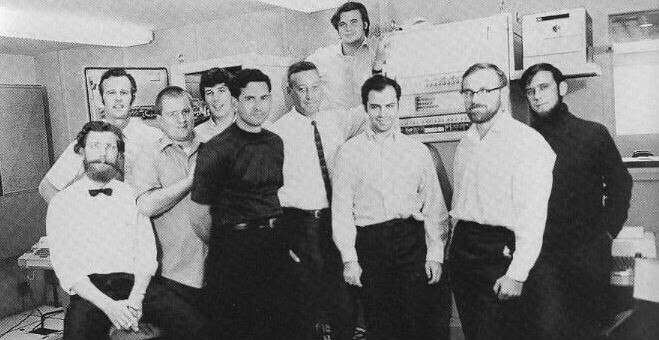
Crowther, a former caver, literally transferred into code the real cave system of Kentucky — Mammoth Cave, where he had once explored tunnels. As a result his daughters (if the tall tales are to be believed), missing their father, got the chance to "travel" through a digital labyrinth, and only your imagination limited the possible detail of the world: "You are in a forest. A path leads north. Branches crunch underfoot…"
Don Woods, another developer, was tinkering with code at the AI department at the time. His classmate, whose name has been lost to time, once burst into the lab shouting: "You have to see this!" On the screen of a Stanford Medical Center terminal flickered a mysterious program — Adventure. How did it get there? Crowther created it at BBN Technologies near Boston, but in an era when the internet was a luxury for the military and files were transferred on magnetic tapes, this was a miracle. Maybe one of the BBN employees secretly brought the code to California? Or it was "leaked" via ARPANET, the precursor to the internet?
Woods copied the game onto a PDP-10 (here's a link to an interesting breakdown of the game, highly recommended — only about half an hour of reading, but very engaging) — a monster the size of a refrigerator. Now a digital cave with trolls and treasures lived on the machine's hard drives. But the delight didn't last long: Crowther's original version was only an executable file in Fortran, which Woods, like an archaeologist, tried to "excavate" through a disassembler. For hours he entered commands like "go north," and then manually analyzed memory dumps to understand how the game reacted to "take key" or "attack gnome." It was a quest within a quest. Woods turned a modest cave simulator into an epic fantasy saga. And all of it — through two-word text commands. The simple two-word commands that Crowther originally devised so his little daughters could understand the game forever entered history thanks to ZIL (Zork Interpretive Language) — the language in which Infocom's games were created.
Imagine Crowther, who worked on ARPANET in the bowels of the ministry of defense, hacking away at this game in the evenings so his children could "travel" through virtual caves while he was off on business trips. And then Woods, a Stanford student, accidentally stumbles onto this code, adds magic, trolls and treasures to it — and so a genre was born that gave us "The Witcher" and Skyrim. A story worthy of a film adaptation in the style of Dan Brown movies, as I see it. Without Adventure there would be neither Skyrim with its caves nor The Witcher with its dialogues. In 2019 Crowther and Woods entered the Academy of Interactive Arts & Sciences Hall of Fame — as the founding fathers of a genre that proved words can be more powerful than graphics.
And those very bearded fellows who by day kicked the poor PDP-10 in attempts to keep the Pentagon from going boom, in the evenings wrote some decent games — well, or almost-games:
MacHack-6 (1966) — Richard Greenblatt
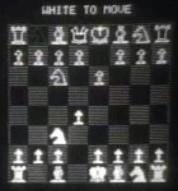
The world's first chess program that participated in a tournament against humans and won. Developed on the basis of Alan Kotok's project for the IBM 7090 computer (a room-sized machine that processed data on punch cards).
The game "Life" (1970) — John Horton Conway
Not a game in the classic sense, but a cellular automaton — a digital "aquarium" where, by set rules, pixel "organisms" are born and die. The player only sets the initial conditions (for example, placing cells) and watches as they evolve into patterns like a "glider" or a "beehive."
Trek (1971) — Don Daglow
A space strategy in the spirit of Star Trek, created on the mainframe of Pomona College. The player controlled a starship, fought the Klingons and saved the galaxy through a text interface. Later Cygnus Software released Star Fleet I — a "souped-up" version with pseudo-graphics for the IBM PC. A green monitor, commands like "NAVIGATE TO SECTOR 5-3" and an alarming beep when enemy ships appeared on the radar.
Hunt the Wumpus (1972) — Gregory Yob
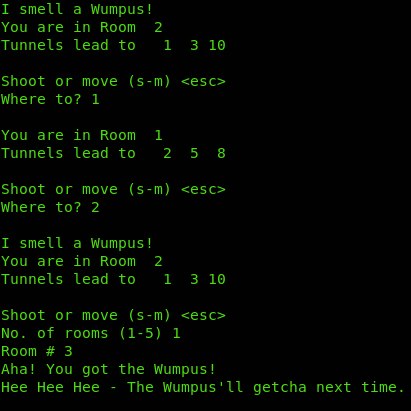
The world's first text RPG puzzle, where the player wandered through a dodecahedron-shaped labyrinth to track down a monster named the Wumpus. The Wumpus smells stronger the closer it is to the player. The caves hid pit traps and super-bats that could carry you off to a random point on the map. To kill the monster you had to shoot an arrow across several rooms, otherwise the Wumpus woke up and... ate you. The game is considered the ancestor of the "survival strategy" genre — without it there would be neither Dark Souls nor Resident Evil. In the 1980s "Hunt the Wumpus" was ported to the ZX Spectrum and Apple II, with primitive graphics added. But the essence stayed the same — text, and meme phrases like: "You smell a stench... the Wumpus is near!".
The Oregon Trail - Don Rawitsch
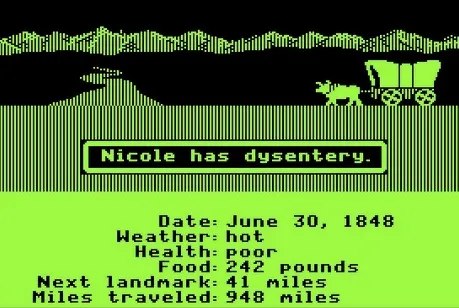
An educational simulator game about pioneers traveling to the Wild West. You had to manage supplies, hunt and avoid diseases. The phrase "You have died of dysentery" became a meme long before the internet. In 1985 it was ported to the Apple II with graphics, but the original version was text-based.
Hamurabi (1968) - Doug Dyment
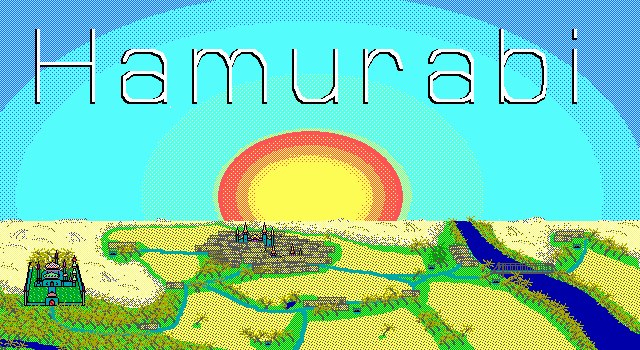
A text strategy where the player governed an ancient city-state: distributing grain, building houses, accounting for famine and revolts. The prototype of all simulators like Civilization and SimCity. In 1973 it was reworked into Kingdom, where... corruption appeared. I caught this game back on a neighbor's Spectrum — I don't know which craftsman ported it, but that version existed too. Too bad I was a kid then and didn't understand a thing about what marvel had landed in my hands. Surprisingly, the browser version also kept me hooked for a couple of evenings; you can try playing it in the browser.
These are only the ones (besides chess) that I tried to play but didn't get into — for that you have to really love text games, and really dislike company; a session of D&D with friends and joking banter is much more interesting.
Almost everything
Here I end this story — beyond it begins the era of PC games and big consoles with their own cults, deities and legends that most of us know. There were Atari/Mattels of their own there too, divisions of territory and major betrayals, but that's a completely different story.
These games are digital frescoes of the last century, scratched out with punch cards on the fossils of rack hardware in mainframe caves. They remind us that even on the power of today's calculator you could create universes. When there were no graphics, games relied on text and imagination, which gave birth to all the now-known genres like RPGs, quests, strategies and simulators. Many developers who later went into big-time game development (Atari, Infocom and Sierra On-Line, Nintendo, Sony) started with text quests on university computers.
← All articles